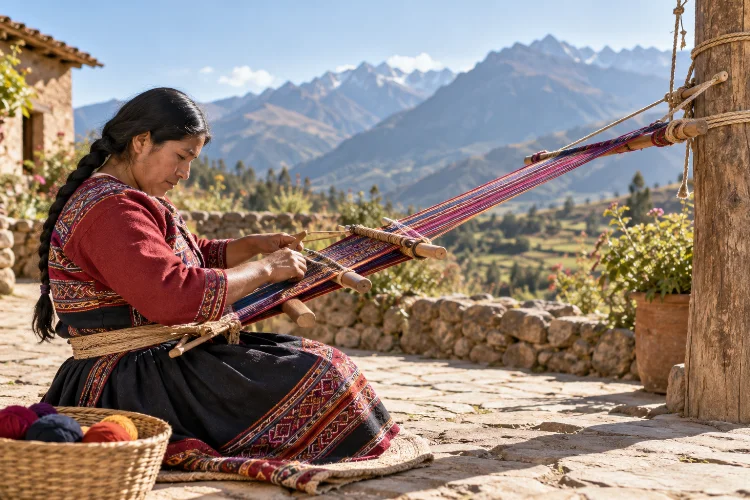
A backstrap loom can look surprisingly simple. Instead of a large wooden frame filled with complicated machinery, it may consist of little more than several wooden sticks, cords, yarn, and a strap wrapped around the weaver’s body.
Yet this modest tool has preserved some of the world’s oldest textile knowledge for generations.
Backstrap loom weaving has deep historical roots in regions including Mesoamerica, the Andes, and parts of Asia and the Pacific.
Archaeological evidence and ancient artwork show that similar weaving systems existed long before industrial textile production. In some communities, techniques developed centuries or even millennia ago are still practiced today.
What makes the backstrap loom especially fascinating is that the weaver becomes part of the machine. By shifting their body backward or forward, they control the tension of the warp threads and influence the structure of the fabric.
Understanding how backstrap loom weaving preserves ancient textile techniques therefore offers more than a lesson in craft. It reveals how technology, cultural identity, artistic knowledge, and community traditions can survive through hands-on practice.
How a Backstrap Loom Actually Works
The basic construction of a backstrap loom is remarkably efficient.
One end of the warp is normally attached to a stable object such as a tree, post, wall, or beam. The opposite end connects to a strap positioned around the weaver’s lower back or waist.
When the weaver leans backward, the warp becomes tighter. Moving forward reduces the tension.
That means the human body effectively becomes part of the loom’s tensioning system.
Other components may include a warp beam, cloth beam, heddle rod, shed stick, shuttle, and weaving sword. A Smithsonian backstrap loom from the Atayal people of Taiwan, for example, contains eight main parts and was used for both plain and twill weaving.
The system is simple enough to transport but technically flexible enough to produce sophisticated fabrics.
Unlike a heavy floor loom, it can often be rolled up when weaving stops. A craftsperson can therefore work in a household courtyard, beside a building, or almost anywhere with a suitable anchor point.
That portability helped make the technology remarkably adaptable.
The Technique Has Deep Roots in Mesoamerica
Backstrap weaving is especially associated with Indigenous textile traditions in Mesoamerica.
The Sam Noble Oklahoma Museum of Natural History explains that archaeological evidence and early historical accounts indicate that backstrap looms were used by cultures throughout much of Mesoamerica before European colonization.
Spanish settlers later introduced treadle looms, but the older technology was never completely replaced.
Ancient Maya artwork provides particularly valuable evidence.
A Maya ceramic figurine dating approximately 650-850 CE depicts a woman using a backstrap loom, demonstrating that the basic technology was recognizable during the Classic Maya period.
The tradition survived because weaving knowledge was repeatedly practiced rather than simply recorded.
RISD Museum notes that Maya women in Guatemala have created complex fabrics on backstrap looms for more than 2,000 years. Modern weaving therefore provides an unusual connection between contemporary craft and ancient material culture.
A loom built today may use newer yarn or slightly different tools, but many of the fundamental movements remain familiar.
That continuity turns weaving into a kind of living archaeological record.
Body-Controlled Tension Preserves Traditional Skills
Modern industrial looms rely on rigid mechanical systems to maintain tension.
A backstrap loom works differently.
Because tension depends partly on the weaver’s posture, successful weaving requires physical awareness. The craftsperson learns how far to lean backward, when to relax the warp, how firmly to beat the weft, and how tension changes the width and density of the cloth.
These skills can be difficult to communicate through written instructions alone.
They are usually learned through observation, repetition, correction, and muscle memory.
A young weaver might watch an experienced family member position the heddle rod, open the shed, insert the weft, and adjust tension hundreds of times before the movements become natural.
This is one reason ancient textile knowledge can survive even when no technical manual exists.
The knowledge lives in the body.
Each generation learns not only what tools to use, but how the tools should feel during production. Small movements that may seem insignificant to an outsider can determine whether a woven edge remains straight or a complex motif develops correctly.
This embodied knowledge is one of the most important forms of cultural preservtion maintained through traditional weaving.
Backstrap Looms Can Produce Remarkably Complex Textiles
Calling the backstrap loom “simple” can be misleading.
Its construction may be straightforward, but the fabrics produced on it can be extremely sophisticated.
A Smithsonian example from the K’iche’ Maya of Guatemala contains warp-predominant plain weave alongside multicolored designs depicting stylized birds and mythical creatures. The decorative imagery was created using supplementary weft techniques often described as brocade.
Weavers can manipulate warp and weft threads to create stripes, geometric patterns, symbolic figures, and complex color arrangements.
Museo Ixchel in Guatemala continues to teach the full process, including preparing the warp, assembling the heddle rod, weaving, and creating designs using warp and brocade techniques.
The ability to create detailed patterns without industrial machinery demonstrates how much technical intelligence is contained in traditional craftsmanship.
A skilled weaver must often plan the textile before production begins.
Thread counts, color sequences, pattern repetition, and garment dimensions need to be considered in advance. Errors made early in the process can affect the final structure many rows later.
The loom may be minimal, but the thinking behind the cloth is anything but basic.
Andean Weavers Preserved Another Ancient Backstrap Tradition
Backstrap loom technology also has extremely deep roots in the Andes.
The Metropolitan Museum of Art describes a Chimú textile produced with a traditional backstrap loom and notes that this type of weaving device had already been used in the Andean region for at least 6,000 years by the time the object was made.
The principle was similar: one side of the loom was anchored while the other was strapped around the weaver.
This allowed the craftsperson to maintain precise control over thread tension.
Archaeological discoveries from Peru show how personally connected women could be to their weaving equipment.
Excavations at Cerro Azul found female burials containing looms, weaving swords, yarn, unfinished textiles, spindles, needles, and other textile tools. Some women were buried with work still attached to their looms.
Such discoveries reveal that weaving was not simply occasional decoration.
It was a specialised skill connected with daily life, identity, economic activity, and sometimes burial practice.
Andean craftspeople could combine cotton with camelid fibers such as alpaca or llama wool, allowing them to create textiles suited to different climates, functions, and visual effects.
The continuing survival of body-tension weaving helps researchers understand how some of these ancient fabrics may have been constructed.
Patterns Preserve Cultural Identity Alongside Technique
Traditional weaving preserves more than manufacturing methods.
It can preserve identity.
Colors, motifs, stripes, garment forms, and pattern arrangements may communicate where a person comes from or which community they belong to.
The Metropolitan Museum of Art notes that clothing patterns in the Guatemalan Highlands have historically signaled cultural and linguistic affiliation. The particular appearance of garments could make someone’s community recognizable to others.
This gives backstrap weaving an important social function.
A pattern is not necessarily just decoration.
It may contain generations of decisions about which colors belong together, how certain forms should be arranged, or which garments are appropriate for particular social situations.
When weaving is passed from one generation to another, these visual languages can survive alongside the physical technique.
Of course, textile traditions are never completely frozen.
Weavers introduce new yarns, colors, motifs, and personal ideas. External influences may also change fashion.
Preservation therefore does not mean producing exactly the same fabric forever.
It means maintaining enough technical and cultural knowledge for communities to reinterpret their traditions without losing the connection to earlier generations.
Teaching Weaving Keeps Knowledge Alive
Ancient craft traditions survive most effectively when people continue practicing them.
A museum can preserve an old textile behind glass, but that does not automatically preserve the knowledge required to reproduce it.
Backstrap weaving requires active learning.
Organizations such as Museo Ixchel continue offering classes in the technique, teaching participants how to prepare yarn, construct the loom, control warp threads, and develop woven designs.
These programs matter because traditional craft knowledge can disappear quickly when younger generations no longer learn it.
Industrial fabrics are cheaper and faster to produce. Mass-market clothing may also reduce demand for handmade garments, while migration and changing lifestyles can make long weaving sessions more difficult.
The challenge is therefore not simply preserving old objects.
It is preserving skilled practitioners.
When experienced weavers teach younger people, they pass along details that archaeological objects alone cannot explain – how tight the warp should feel, how quickly a pattern should develop, how to correct mistakes, and how specific materals respond under tension.
That living transmission is what keeps an ancient technology functional rather than merely historical.
Why the Backstrap Loom Still Matters Today
In an age of computerized textile manufacturing, the backstrap loom may appear technologically outdated.
But efficiency is not the only way to measure technology.
The loom uses very little infrastructure, consumes no electricity, can often be made from locally available materials, and gives the weaver direct control over almost every stage of fabric construction.
It also challenges the assumption that advanced design requires complicated machinery.
A sophisticated textile can emerge from a handful of wooden rods because the real complexity is stored in the craftsperson’s knowledge.
This has important implications for understanding ancient technology.
Archaeologists sometimes recover only simple tools, yet those tools may have supported extremely complex production systems. The intelligence was not necessarily built into the machine itself.
It was carried by the person operating it.
Backstrap weaving makes that relationship unusually visible.
The loom, body, thread, and learned technique function together as a single technological system.
Backstrap loom weaving preserves ancient textile techniques because it keeps both the tools and the knowledge behind them alive.
From Classic Maya communities in Mesoamerica to ancient Andean weaving traditions, generations of craftspeople have used body-controlled tension, carefully prepared warps, and complex thread manipulation to create sophisticated fabrics.
Its survival also demonstrates that cultural preservation is not simply about protecting museum objects. Skills must be practiced, taught, adapted, and passed forward.
Today, every artisan who learns how to warp a backstrap loom or create a traditional woven pattern participates in that continuity.
If you want to understand ancient textile technology more deeply, study the people who still practice traditional weaving. Their movements, tools, and techniques can reveal parts of textile history that archaeological fragments alone cannot preserve.