Long before digital design software or computerized weaving machines existed, textile makers were already producing fabrics covered with flowers, animals, geometric shapes, human figures, and repeating architectural motifs.
Some designs were so complicated that it is difficult to imagine them being created entirely by hand. One of the technologies that made this possible was the drawloom.
Exploring complex pattern formation on historic drawloom systems reveals an impressive combination of mechanical engineering, artistic planning, and skilled teamwork.
Unlike simpler looms that mainly controlled groups of warp threads for basic structures, the drawloom added a separate pattern-control system.
Selected warp threads could be lifted according to a planned sequence, allowing individual areas of a textile to form detailed images. The technology became especially important in luxury silk weaving in China, Western Asia, Byzantium, and later European manufacturing centers.
Drawloom weaving was slow and expensive, but it allowed craftspeople to transform thread into something remarkably close to woven illustration. Its influence would eventually lead toward one of the most important inventions in textile automation: the Jacquard mechanism.
What Made the Historic Drawloom Different?
At first glance, a drawloom still followed the basic principle used by most weaving technologies.
Warp threads were stretched lengthwise on the loom, while weft threads passed across them. By raising and lowering selected warp threads, the weaver created a shed through which the weft could travel.
The major difference was pattern control.
A conventional loom might use several shafts or heddles to raise entire groups of warp threads. That arrangement works extremely well for regular structures such as plain weave, twill, or relatively simple geometric patterns.
A drawloom added another system specifically for decorative design.
Pattern cords connected groups or individual sets of warp threads to a figure harness. The Smithsonian Museum Conservation Institute notes that Chinese drawlooms could produce both small and large designs through interactions between draw strings and pattern-related threads.
This meant the loom could control the basic fabric structure and the decorative image separately.
In practical terms, the weaver was no longer limited to patterns created only by repeating a small number of shaft combinations. Far larger motifs could be built across the textile.
Pattern Cords Worked Like an Early Information System
The most fascinating part of a drawloom was not simply its size. It was the way information about a design was translated into mechanical actions.
Before weaving began, the pattern had to be carefully planned.
Groups of warp threads were connected to pattern cords representing specific areas of the design. Pulling one combination might raise threads forming part of a flower, while another combination could create the outline of an animal or geometric border.
Each sequence functioned almost like an instruction.
That makes the drawloom surprisingly similar in concept to later programmable machinery. The loom itself did not “understand” the picture. Instead, the arrangement of cords stored instructions about which threads needed to move.
Historic designers therefore had to think in two languages at once.
They needed to imagine the visual appearance of the finished textile while also understanding how that image could be translated into warp and weft structures.
This required considerable technical knowlege.
An attractive drawing was not automatically a workable textile pattern. Curves, shading, color changes, and repeated motifs had to be redesigned according to what the loom could physically reproduce.
Weaver and Drawboy Had to Work as a Team
Traditional drawloom weaving often required two people.
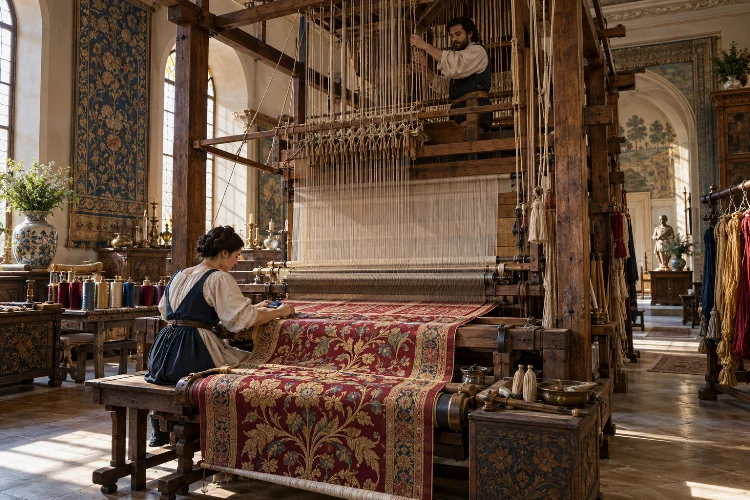
The main weaver sat at the loom and controlled the ordinary weaving process, including inserting the weft and managing the ground structure. Above or beside the loom, an assistant—often called a drawboy in European textile production—operated the pattern cords.
The Metropolitan Museum of Art explains that European patterned silk production before industrialization commonly required both a skilled weaver and a drawboy who controlled the pattern mechanism.
Their timing had to be extremely precise.
For every relevant section of the pattern, the assistant pulled the correct cords, raising selected warp threads. The weaver then inserted the appropriate weft before the next pattern combination was prepared.
One incorrect pull could distort the motif.
This made communication and repetition essential. Experienced teams could develop an almost rhythmic coordination, with one person controlling pattern selection while the other controlled the actual formation of cloth.
The labor requirement also contributed to the high price of patterned silks.
A complex textile represented not only expensive materials but many hours of work from several specialised craftspeople.
Chinese Pattern Looms Helped Drive Drawloom Development
China played a major role in the history of complex patterned weaving.
Chinese textile technology evolved through several loom systems, including breast looms, inclined looms, multi-heddle systems, and later drawlooms.
Smithsonian research notes that drawloom technology developed from earlier Chinese loom traditions and eventually became capable of creating both large and small decorative patterns.
Archaeological evidence has helped researchers understand this development more clearly.
Small model looms discovered in a Han dynasty tomb in Chengdu have provided evidence of sophisticated pattern-weaving technology more than two thousand years ago.
Researchers have described these finds as an important technological link between earlier weaving systems and later drawlooms.
By the Tang dynasty, textile technology had developed further.
Research catalogued by the Smithsonian Museum Conservation Institute shows that Chinese silk weaving shifted toward drawloom technology during this period, improving both production efficiency and the ability to create expressive floral and animal imagery.
This was particularly important because Chinese silk was already moving through international trade networks.
The movement of luxury textiles helped spread not only finished cloth but weaving knowledge and visual ideas across Eurasia.
Repeating Patterns Made Complex Designs More Practical
A historic drawloom was especially effective when creating repeating designs.
Instead of treating an entire fabric as one enormous unique picture, textile designers often developed a repeat unit. Once the required cord sequence had been organized, that same pattern could be produced again and again across the cloth.
Repeats might contain medallions, flowers, birds, animals, vines, or paired human figures.
Byzantine silk provides excellent examples.
The Metropolitan Museum of Art explains that drawloom-woven Byzantine textiles frequently featured confronting or back-to-back motifs repeated within roundels or lattice structures. Designers paid particular attention to hiding the borders where one repeat unit joined the next.
This created the visual impression of an uninterrupted surface.
Repeats were also economically useful.
Preparing a complicated drawloom could require substantial time, but once the system had been correctly arranged, multiple lengths of the same design could be woven.
This balance between artistic complexity and repeatable production helped make the technology valuable in luxury workshops.
It also explains why historic patterned silks could function as fashionable commercial products rather than only one-of-a-kind artworks.
Drawlooms Made Figural Silk Possible
Geometric patterns can often be produced using relatively simple loom arrangements.
Human figures and narrative scenes are much more difficult.
A face, animal, bird, or religious scene may require many small areas of warp to behave differently from neighboring sections. Drawloom pattern systems gave weavers far greater control over those areas.
A surviving Byzantine silk depicting the Annunciation demonstrates what the technology could achieve.
The Metropolitan Museum of Art describes the textile as an exceptionally sophisticated example produced using an advanced figure-harness drawloom.
Its technical complexity suggests that it may have been manufactured in an imperial workshop with access to skilled labor and considerable resources.
Drawlooms also supported compound structures such as samite.
The Met notes that polychrome silk woven with drawloom technology could combine complicated designs with multiple colors using compound twill structures.
These textiles were effectively pictures built from structural decisions.
Instead of applying decoration afterward through paint or printing, the image was formed directly through the crossing of warp and weft.
That required extraordinary planning.
Persian and Islamic Workshops Refined Repeating Silk Design
As drawloom weaving spread and developed across Asia and the Middle East, different regions created distinctive visual traditions.
Persian silk weaving became particularly sophisticated.
During the Safavid era, Iranian textile designers created continuous repeat patterns containing flowers, birds, deer, rabbits, and human figures.
The Metropolitan Museum of Art notes that master designers known as naqshband developed patterns specifically intended to hide the boundaries between repeat blocks.
That was an impressive technical achievement.
A designer had to understand not only how a single motif looked but how it would connect above, below, and beside neighboring repeats.
Drawloom weaving also flourished across regions such as Spain and North Africa.
A fifteenth-century silk curtain in The Met’s collection reflects the strong historic tradition of drawloom weaving shared across these areas.
Textiles therefore provide evidence of technological exchange as well as artistic influence.
Motifs could migrate between Persia, Central Asia, the Ottoman world, Byzantium, India, and Europe, while local workshops adapted the technology to their own materials and visual preferences.
European Silk Workshops Pushed the System Further
By the seventeenth and eighteenth centuries, European silk centers were producing increasingly ambitious drawloom fabrics.
Designers had to understand the machine almost as deeply as the weavers.
The Victoria and Albert Museum’s Leman Album preserves textile designs created by James Leman in early eighteenth-century London.
The V&A notes that his designs reveal a strong understanding of how the complicated drawloom mechanism could be exploited to reproduce bold floral and architectural patterns.
This highlights an important point about historic textile design.
The designer could not work independently from manufacturing technology.
Pattern scale, repeat size, weave structure, available colors, and loom configuration all influenced what could successfully be produced.
Luxury weaving centers therefore relied on networks of designers, loom builders, silk merchants, dyers, drawboys, and highly trained weavers.
The finished textile may appear effortless, but behind it stood an entire system of technical collaboration.
Drawloom Limitations Inspired the Jacquard Revolution
For all its sophistication, the drawloom had major disadvantages.
Setting up a new design could be extremely slow. Complex pattern systems required many cords, careful organization, and skilled assistants.
Changing from one large design to another could mean rebuilding much of the pattern-control arrangement.
This created pressure for a more efficient system.
In 1801, Joseph Marie Jacquard introduced a mechanism that improved control of patterned weaving through punched cards.
The Metropolitan Museum of Art explains that the Jacquard system eventually replaced conventional drawloom pattern control, dramatically reducing setup difficulties and eliminating the traditional drawboy role.
Punched cards stored pattern instructions in a more flexible form.
Different cards corresponded to different thread selections, allowing complicated designs to be repeated mechanically with much less manual intervention.
The concept was revolutionary, but it did not appear from nowhere.
Drawloom technology had already established the fundamental principle that complex visual information could be translated into instructions controlling individual groups of threads.
Jacquard simply made that system more efficient and programmable.
In that sense, historic drawlooms helped create one of the conceptual ancestors of automated manufacturing.
Why Historic Drawloom Technology Still Matters
Drawloom systems are important because they challenge the idea that pre-industrial technology was mechanically simple.
These looms could convert abstract artistic designs into structured thread movements using cords, harnesses, heddles, and carefully coordinated human actions.
The machine itself was complex, but so was the knowledge surrounding it.
Weavers had to understand tension, yarn behavior, color placement, weave structure, and pattern alignment. Designers had to convert drawings into technically possible repeat units. Assistants had to operate complicated cord sequences without losing their place.
Modern craftspeople still demonstrate the technique.
The Victoria and Albert Museum has highlighted contemporary workshops in India that use historic-style drawlooms to recreate complex Mughal-inspired silk textiles with gold and silver thread.
These surviving practices show that drawloom weaving is not simply obsolete machinery.
It is evidence of a sophisticated relationship between human memory, design, and mechanical pattern control.
Exploring complex pattern formation on historic drawloom systems reveals one of the most remarkable chapters in textile technology.
By separating pattern control from the basic weaving structure, drawlooms allowed craftspeople to create elaborate flowers, animals, human figures, medallions, and repeating imagery directly within woven cloth.
Chinese innovations helped develop the technology, while Persian, Byzantine, Islamic, and European workshops expanded its artistic possibilities.
Skilled weavers and assistants turned complicated cord sequences into luxury fabrics that could require enormous investments of time and expertise.
Eventually, the Jacquard mechanism made pattern control faster and more automated, but the basic idea had already been proven.
Look closely at a historic patterned silk and you are not simply seeing decoration. You are looking at an early form of programmable design created centuries before modern computers existed.