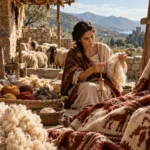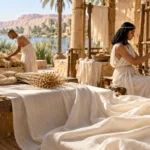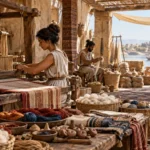
Before mechanized factories, power looms, and synthetic fibers, making cloth was one of humanity’s most demanding technologies.
A simple garment could begin in a flax field, sheep pasture, cotton crop, or silkworm nursery before passing through the hands of spinners, dyers, weavers, and finishers.
Understanding ancient textile technologies across civilizations reveals just how inventive early societies actually were.
Egyptians developed sophisticated linen-processing methods, Mesopotamian communities created large wool industries, Greek households relied heavily on spinning and weaving, Chinese craftspeople mastered sericulture, and Andean weavers produced extraordinarily complex fabrics from cotton and camelid fibers.
These technologies were not isolated crafts. Textile production influenced agriculture, household labor, trade, social status, religion, and even political economies.
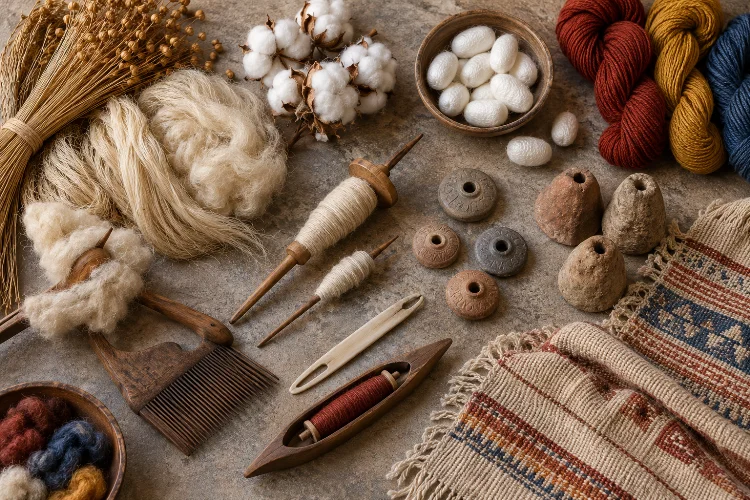
Archaeological discoveries such as spindle whorls, loom weights, preserved fabrics, needles, dye residues, and artistic representations allow researchers to reconstruct this hidden technological world.
Stone temples may survive more dramatically, but ancient fabric tells another story: civilization was built not only with stone and metal, but also with thread.
Fiber Selection Was the Foundation of Textile Technology
Every textile tradition started with one basic question: what fibers were locally available?
Ancient Egyptians relied heavily on flax, which could be processed into linen. The long bast fibers inside the flax stem were carefully separated, divided according to the fineness of yarn required, and prepared for spinning.
UCL’s Digital Egypt research shows that Egyptian textile workers developed highly specialized methods for processing these fibers over thousands of years.
Other regions developed around different raw materials.
In Mesopotamia and much of the Mediterranean, wool became extremely important because sheep supplied renewable fleece.
In parts of the Andes, craftspeople worked with cotton and fibers from camelids such as llamas and alpacas. Chinese textile specialists eventually developed silk production based on silkworm cultivation.
Local geography therefore shaped textile technolgy.
Warm agricultural valleys could support flax or cotton, while pastoral landscapes favored wool. High-altitude Andean environments encouraged extensive use of camelid fibers.
Yet civilizations rarely remained limited to local materals forever. Trade gradually introduced foreign fibers, dyes, fabrics, and manufacturing ideas, expanding the possibilities available to ancient craftspeople.
Spinning Turned Loose Fibers Into Valuable Yarn
Before any loom could be used, fibers had to become thread.
Spinning seems simple at first, but controlling fiber thickness, twist, strength, and consistency requires considerable practice. One of the most important ancient spinning tools was the spindle, often fitted with a weighted spindle whorl that helped maintain rotation.
Ancient Egypt provides an interesting example of how spinning technology could differ from modern expectations.
UCL researchers describe a “spliced and twisted” linen yarn technique used during dynastic Egypt from roughly 3500 to 600 BCE. Fibers were prepared into strips, connected into longer lengths, and later twisted using a spindle.
Earlier prehistoric Egyptian yarn could even be produced without a spindle by rubbing fiber elements together by hand or against another surface.
Wool required somewhat different handling.
At the Iron Age site of Gordion in Anatolia, archaeologists have recovered more than one thousand spindle whorls. Differences in their sizes and weights suggest that workers could produce different types of yarn for different textile purposes.
Tiny tools therefore reveal a surprisingly sophisticated understanding of fiber mechanics.
Looms Changed How Ancient Societies Produced Cloth
The loom was one of the most important technological developments in textile history.
At its simplest, weaving involves crossing horizontal weft threads through vertical or lengthwise warp threads. But controlling dozens or hundreds of individual threads required tools that maintained tension and allowed workers to create consistent structures.
Different civilizations developed several loom designs.
Egyptian weavers used horizontal ground looms during early periods, while other loom forms appeared later. Evidence from paintings, models, preserved textiles, and weaving equipment shows that Egyptian loom technology had already developed basic principles surprisingly early.
UCL notes similarities between weaving representations dating to around 3600 BCE and later Middle Kingdom workshop models.
In the Mediterranean and Anatolia, the warp-weighted loom became particularly important.
Threads hung vertically from a frame while clay or stone weights maintained tension. At Gordion, large numbers of loom weights discovered in specialized buildings indicate organized textile manufacturing rather than occasional household production.
A loom was therefore more than a craft tool. Improvements in loom organization could increase productivity and allow larger, stronger, or more detailed fabrics to be produced.
Egyptian Linen Shows How Specialized Textile Skills Became
Ancient Egyptian linen offers one of the clearest examples of long-term textile innovation.
Flax had to be harvested, stripped, divided, prepared, spun, woven, washed, and sometimes finished through additional processes. Each step affected the final quality of the cloth.
Egyptian craftspeople also understood practical details that might surprise modern readers.
UCL’s textile research notes that moisture could help when spinning particularly fine linen yarn. Prepared material could be pulled through water before spinning, making delicate fibers easier to handle.
Egyptian spinners are also depicted managing two spindles simultaneously, suggesting impressive levels of practiced coordination.
Textile production eventually became organized within workshops as well as households.
Models and archaeological finds show workers carrying out different stages of production in coordinated environments.
This specialization allowed Egyptian producers to create everything from sturdy everyday linen to exceptionally fine fabrics associated with wealthy households and ceremonial settings.
The process demonstrates how craftmenship could accumulate across generations. Textile workers did not need written engineering manuals; practical knowledge was transmitted through repeated experience.
Wool Production Supported Large Ancient Industries
Wool changed textile economies because sheep could provide fleece repeatedly without being slaughtered.
Once societies began breeding and managing large flocks specifically for textile production, wool became an important renewable resource. Shepherding, spinning, dyeing, weaving, and trading could form interconnected economic sectors.
The archaeological evidence at Gordion shows just how organized this could become.
Penn Museum researchers describe specialized workshop areas containing standardized spindle whorls and loom weights.
Different qualities of cloth appear to have been produced, and textiles likely functioned both as prestige objects and media of exchange within the Phrygian political economy.
Ancient Greek society also depended heavily on wool processing.
In Classical Greece, spinning and weaving were strongly associated with household management and women’s work. The Metropolitan Museum of Art notes that textile production was considered one of the principal responsibilities of Greek women.
This reminds us that ancient technologies were not always concentrated in formal workshops.
Millions of hours of technical production occurred inside ordinary households, where textile knowledge could be passed from one generation to another.
Chinese Sericulture Created an Extraordinary Luxury Textile
Silk required a completely different technological system.
Rather than harvesting plant fibers or animal fleece, silk producers cultivated silkworms and collected the long protein filaments forming their cocoons.
The process, known as sericulture, depended on carefully managing both silkworm populations and their supply of mulberry leaves.
According to UNESCO, Chinese traditions place the development of sericulture around 2700 BCE.
Silk eventually became an extremely valuable material associated with imperial courts, prestige goods, and long-distance trade. Its production methods were closely guarded for centuries.
Silk presented unusual manufacturing opportunities because its extremely fine filaments could produce lightweight yet visually luxurious fabrics.
Chinese weavers eventually created gauze, brocade, embroidered fabrics, and other sophisticated structures. Complete silk garments dating from the fourth and third centuries BCE have survived in Chinese tomb contexts.
The technology also had economic consequences far beyond China.
Silk moved through trade networks stretching across Central Asia toward Western Asia and the Mediterranean, while technical knowledge gradually spread along similar routes.
UNESCO emphasizes that Silk Roads exchanges transmitted not just commodities but also craft knowledge and technology.
Andean Weavers Turned Textiles Into Complex Art
Ancient textile innovation was not limited to Eurasia.
In the Andes, cloth became one of the most culturally important artistic forms. The Metropolitan Museum of Art describes textiles as having exceptional importance in the region since at least the second millennium BCE.
Andean weavers worked with cotton as well as camelid fibers. They used weaving, plaiting, knotting, dyeing, and other techniques to produce garments and ceremonial textiles with striking colors and intricate patterns.
Tapestry weaving became particularly sophisticated.
In this technique, colored weft threads completely cover the warp, allowing weavers to create detailed visual designs.
Wari craftspeople, active roughly between 650 and 1000 CE, produced highly complex tapestry-woven garments featuring geometric arrangements and transformed representations of people, animals, and supernatural figures.
Technical sophistication also served cultural purposes.
Colors, fiber quality, garment forms, and motifs could communicate political, occupational, or social status. Textiles accompanied the dead as well, including as wrappings for sacred mummy bundles.
The loom was effectively both a production machine and an artistic medium.
Dyeing Added Chemistry to Ancient Textile Production
Color made textile manufacture even more technically demanding.
Ancient dyers needed to understand how pigments interacted with different fibers, how long materials should remain in dye baths, and how substances known as mordants could help certain colors attach more effectively.
Natural dye sources included plants, insects, mollusks, minerals, bark, roots, and other locally available substances.
Producing consistent colors was difficult, which made particularly bright or durable shades valuable. Some dyes also required materials gathered or traded over considerable distances.
Textile color therefore connected practical chemistry with economics and symbolism.
A rare dye might identify an elite garment. A certain pattern could communicate regional identity. Imported coloring materials might reveal long-distance trade relationships.
UNESCO’s study of textiles along the Silk Roads highlights how dyes, patterns, techniques, and decorative traditions travelled between societies. Foreign styles were not always simply copied; they were often reinterpreted and combined with local traditions.
Ancient clothing could therefore preserve evidence of cultural interaction in its very colors.
Textile Technologies Helped Connect Civilizations
Perhaps the most fascinating part of ancient textile history is how quickly a local craft could become part of a wider network.
Finished fabrics travelled because they were relatively portable yet potentially extremely valuable. Traders could transport silk, wool garments, cotton cloth, or decorated textiles much more efficiently than many bulky raw commodities.
But fabric was not the only thing moving.
Spindle designs, weaving methods, patterns, dye recipes, fibers, artistic motifs, and production knowledge could travel with merchants and craftspeople.
UNESCO describes the Silk Roads as networks through which goods, technologies, beliefs, artistic traditions, and scientific knowledge circulated over enormous distances. Some sections eventually connected trade systems extending thousands of kilometers across Eurasia.
Textiles are especially useful for understanding this exchange because they combine technology and culture.
The structure of a weave can reveal manufacturing knowledge. Fiber can suggest agricultural or pastoral practices. Dyes may indicate access to distant resources, while designs can expose foreign artistic influences.
A fragment of cloth is almost like an archaeological database woven into thread.
Understanding ancient textile technologies across civilizations shows that early fabric production was anything but primitive.
Egyptian workers mastered delicate linen processing, Mediterranean societies built major wool industries, Chinese specialists developed sericulture, and Andean weavers transformed cotton and camelid fibers into technically complex works of art.
Spindles, looms, dyes, and fiber-processing methods were important technologies that shaped household economies, specialized workshops, commerce, identity, and cultural exchange.
More importantly, textile innovation rarely remained within a single region. Fabrics and production knowledge travelled through trade networks, allowing techniques and artistic ideas to influence distant societies.
So when exploring ancient civilizations, look beyond palaces, weapons, and monumental architecture. Study their textiles too. The smallest surviving thread can reveal how people worked, traded, created, and shared technology across the ancient world.