For much of ancient history, silk was far more than a beautiful fabric. It could represent wealth, political influence, technological knowledge, and access to international trading networks stretching across thousands of kilometers.
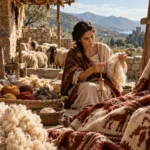
Producing silk was also surprisingly complicated. Silkworms had to be carefully raised, mulberry leaves supplied as food, cocoons collected at the right moment, and extremely fine filaments unwound before they could be woven into luxurious cloth.
For centuries, Chinese producers possessed knowledge that few outsiders could reproduce. That technological advantage helped make silk one of the most valuable commodities of the ancient and medieval worlds.
Understanding how silk production transformed historical trade and diplomacy reveals something much bigger than the story of clothing.
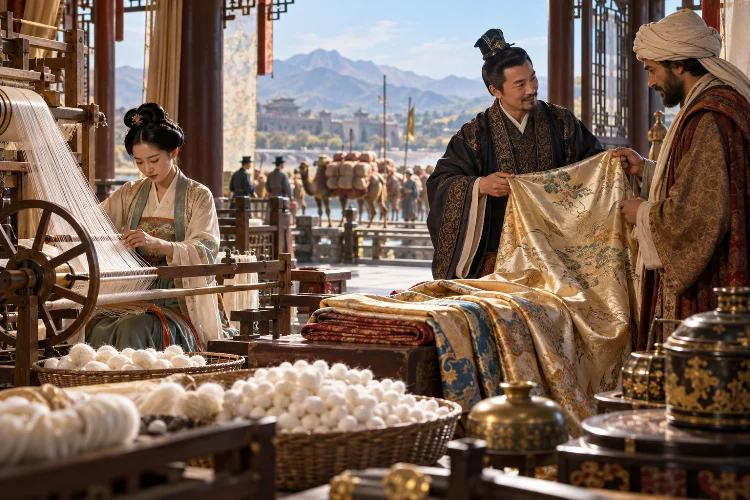
Silk helped connect China with Central Asia, Persia, India, Byzantium, and eventually the Mediterranean. It travelled as merchandise, tribute, diplomatic gifts, and symbols of imperial prestige.
Along those same routes moved merchants, ambassadors, religions, artistic ideas, and technologies, turning silk into one of history’s most influential global commodities.
China’s Early Silk Production Created a Valuable Monopoly
Silk begins with sericulture: the controlled raising of silkworms, especially Bombyx mori, whose cocoons contain long continuous fibers.
Chinese communities gradually developed sophisticated methods for cultivating mulberry trees, raising silkworms, unwinding cocoons, spinning fibers, dyeing thread, and weaving complex fabrics. The resulting material was lightweight, durable, smooth, and visually striking.
For centuries, knowledge of this production process was carefully protected.
UNESCO notes that silk was initially associated with China’s imperial court and was used for prestigious garments, banners, draperies, and other luxury objects.
Chinese authorities guarded the techniques of production closely, helping maintain their advantage over foreign competitors.
That technological exclusivity gave silk tremendous economic value.
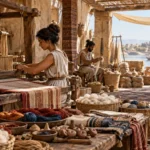
Unlike grain or timber, a relatively small amount of silk could represent huge amounts of specialized labor. It was therefore ideal for transporting across dangerous long-distance trade routes where merchants needed goods valuable enough to justify the cost and risk of travel.
Silk Became an Ideal Long-Distance Trade Commodity
The geography of Eurasian trade was difficult.
Merchants moving between China and western regions encountered deserts, mountain passes, grasslands, political borders, and areas controlled by competing kingdoms. Transporting bulky low-value commodities across such distances was rarely practical.
Silk solved that problem remarkably well.
It was light, compact, valuable, and highly desirable among wealthy consumers.
UNESCO describes China as a major supplier of silk to Central Asia, the Indian subcontinent, Western Asia, and the Mediterranean world as long-distance exchanges expanded significantly from around the second century BCE.
The Silk Roads were not one continuous highway. They were shifting networks of caravan trails, cities, mountain passages, maritime connections, and regional trading routes.
Most merchants did not travel from China all the way to Rome. Instead, commodities frequently passed from one group of traders to another.
A bolt of Chinese silk might therefore cross several political territories before reaching its final buyer. Each transfer created opportunities for merchants, rulers, customs officials, and middlemen to profit.
Han Diplomacy Helped Expand the Silk Roads
One of the most interesting aspects of Silk Road history is that diplomacy helped expand trade.
During the Han dynasty, Emperor Wu sent the envoy Zhang Qian westward in 139 BCE. His original goal was political rather than commerical: he was seeking potential alliances against the Xiongnu.
The mission did not go smoothly. Zhang Qian was captured and detained for years before eventually returning to China.
Yet the geographical and political information he brought home proved extremely valuable. His reports increased Chinese knowledge of Central Asian kingdoms and encouraged further diplomatic missions toward western regions.
UNESCO identifies Zhang Qian’s journeys as important steps in establishing stronger connections between China and Central Asia. A second mission in 119 BCE helped deepen relationships with neighboring peoples and emerging exchange networks.
Trade followed those diplomatic connections.
Silk increasingly travelled west while horses, precious stones, glassware, metals, and other foreign goods moved toward China.
This is an important reminder that early globalization was often created by diplomacy and commerce working together.
Central Asian Merchants Turned Silk Into an International Business
China produced much of the silk, but Central Asian merchants played a major role in moving it.
Groups operating between Chinese territories, Iranian lands, and Mediterranean markets became essential intermediaries. Among the most famous were Sogdian merchants, whose networks eventually stretched across much of Central Asia.
Earlier Parthian merchants and rulers also benefited from their geographic position between East and West.
UNESCO notes that silk trade between Han China and regions extending toward the Iranian Plateau became increasingly important, while caravan cities flourished across major routes connecting Central Asia and the Middle East.
Merchants carried more than physical goods.
Travelling commercial communities helped transmit languages, religious ideas, artistic motifs, financial practices, and practical information about distant societies.
Buddhism, Christianity, Zoroastrianism, and Manichaeism all moved through parts of the same interconnected world.
Silk therefore contributed indirectly to cultural globalization. The routes created to move expensive textiles also provided infrastructure for moving ideas.
Silk Became a Powerful Tool of Diplomacy
Luxury textiles were especially useful to rulers because their value went beyond money.
A diplomatic gift made from silk could demonstrate generosity, wealth, technological superiority, and political status simultaneously.
Chinese rulers used silk in diplomatic exchanges with neighboring societies, and UNESCO describes silk as both a major commercial commodity and an important diplomatic gift.
The practice later became highly visible in Byzantium.
Byzantine rulers used elaborate textiles as part of carefully controlled diplomatic rituals. Fine silks could be presented to ambassadors, rulers, military allies, or influential foreign elites.
Cambridge research on Byzantine diplomacy shows that textiles formed part of imperial gift-giving strategies intended to reinforce alliances and project the generosity and authority of the emperor.
Diplomatic representatives even needed to decide carefully how many valuable gifts should be offered during negotiations.
Silk could therefore function almost like political currency.
Giving an impressive textile was not simply an act of kindness. It could create obligation, communicate hierarchy, reduce hostility, or encourage cooperation.
Byzantium Changed the Balance of Silk Production
For centuries, Mediterranean consumers depended heavily on silk arriving from the East.
Byzantine elites particularly valued the fabric. Court clothing made from shimmering silk communicated privileged access to distant trade networks and enormous wealth.
That dependence created a strategic problem.
Eastern trade passed through territories controlled by competing powers, especially the Sasanian Persian Empire. If political relations deteriorated, access to imported silk could become more difficult or expensive.
During the sixth century, this situation began to change.
Historical sources discussed by Cambridge researchers describe how knowledge of sericulture reached Byzantium during the reign of Emperor Justinian I.
Accounts traditionally describe monks bringing information – and silkworm material – from regions farther east, allowing silk production to develop inside Byzantine territory.
This transfer of technolgy had major consequences.
Byzantium no longer needed to rely entirely on imported raw silk. Imperial and private textile workshops eventually developed sophisticated silk industries, particularly in Constantinople and other production centers.
Silk production had effectively become a matter of economic security and geopolitical competition.
Imperial Silk Became a Symbol of Political Power
Once Byzantium developed stronger domestic production, rulers could control who received the most prestigious fabrics.
Certain colors, patterns, and garments became closely associated with the imperial court. Purple silk in particular carried powerful political symbolism, with some forms reserved for the emperor.
Research from the Metropolitan Museum of Art notes that Byzantine silk production was closely tied to state-sponsored workshops and regulations governing who could wear particular luxury fabrics.
Cambridge research similarly describes silk garments as visible expressions of Byzantine political culture. Imperial rulers could distribute prestigious textiles to officials and foreign elites while limiting access to particularly desirable varieties.
That controlled scarcity increased their symbolic power.
Silk could communicate that the wearer belonged to an exclusive circle connected with the emperor.
Even foreign rulers wanted Byzantine textiles. Silk garments and hangings appear in records describing diplomatic exchanges between Byzantium and Islamic courts, showing how luxury fabrics crossed religious and political boundaries.
Prestiege was literally woven into the material.
Silk Trade Carried Ideas Alongside Fabric
The historical importance of silk cannot be measured only by how much money merchants earned from it.
Trade networks created repeated contact between cultures that might otherwise have remained geographically distant.
Artistic motifs moved between Chinese, Central Asian, Persian, Byzantine, and Islamic textile traditions. Craftspeople adopted foreign patterns and production methods, often adapting them to local tastes.
The Silk Roads also facilitated the movement of religions, scientific knowledge, technologies, artistic styles, and political ideas.
UNESCO describes the wider route system as one of history’s major networks of cultural exchange, linking civilizations across Asia, Central Asia, Western Asia, and the Mediterranean.
That broader legacy may be silk’s greatest historical contribution.
A luxury fabric created demand for stronger trade networks. Those networks encouraged diplomacy. Diplomacy opened additional markets, and merchants traveling between them became carriers of information and culture.
What started with silkworms and mulberry leaves eventually helped connect an enormous part of the ancient world.
Silk production transformed historical trade and diplomacy because it combined technological difficulty, portability, beauty, and enormous value in one remarkable material.
China’s early expertise created a powerful commercial advantage, while Han diplomatic missions strengthened connections with Central Asia.
Merchants then carried silk across vast networks reaching Persia, Byzantium, and the Mediterranean, where rulers turned luxurious textiles into symbols of wealth and political authority.
When sericulture eventually spread beyond China, silk production itself became part of geopolitical competition.
Yet silk’s greatest legacy extends beyond commerce. The networks built around it helped move religions, technologies, artistic traditions, and diplomatic ideas across continents.
Explore the Silk Roads closely and you will discover that a simple thread could connect emperors, merchants, ambassadors, craftspeople, and civilizations thousands of kilometers apart.