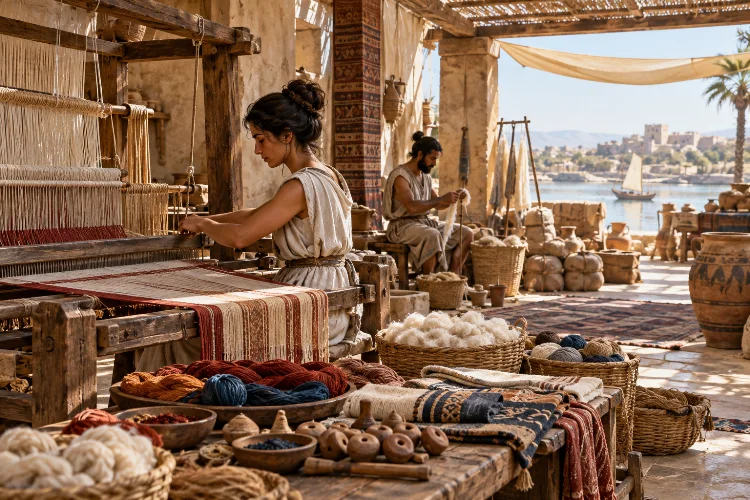
Long before factories produced clothing by the millions, making a single piece of fabric could require days or even months of careful work.
Fibers had to be harvested, cleaned, spun into thread, dyed, and finally woven by hand. What looks like an ordinary piece of cloth today could therefore represent enormous economic and social value thousands of years ago.
Ancient textile traditions were much more than early fashion. They influenced agriculture, labor organization, technological innovation, religious ceremonies, social hierarchy, and international trade.
Linen became closely connected with ancient Egypt, wool supported major industries in Mesopotamia, cotton developed into an important material in South Asia, silk became one of China’s most famous exports, and complex weaving traditions flourished independently in the Andes.
Because textiles were portable and valuable, they also travelled between distant societies. Along with fabric came patterns, dyes, tools, production techniques, and cultural ideas. In many ways, the history of civilization was also a history woven from thread.
Textile Production Was an Early Technological Revolution
Turning raw plants or animal fibers into usable cloth required surprisingly sophisticated knowledge. Ancient craftspeople needed to understand which plants produced strong fibers, how sheep or other animals should be managed, and how thread tension affected finished fabric.
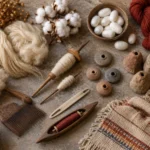
Spinning was one of the most important steps. Using tools such as spindle whorls, workers transformed loose fibers into continuous yarn. Looms then allowed those threads to be arranged into increasingly complex woven structures.
Ancient Egyptian textile production demonstrates how advanced these skills became.
Archaeological evidence shows that Egyptian craftspeople developed highly refined methods for preparing flax, spinning linen yarn, and operating different forms of looms over thousands of years.
UCL’s Digital Egypt project notes evidence for Egyptian linen production techniques stretching back into the fourth millennium BCE.
These technologies may seem simple compared with modern machinery, but they represented major innovations. Improving a spindle, loom, dyeing process, or fiber preparation method could increase production and create better-quality cloth.
Linen Became Part of Ancient Egyptian Identity
Few civilizations are as strongly associated with a textile as ancient Egypt is with linen. The material was produced from flax, a crop well suited to the agricultural environment of the Nile Valley.
Linen served practical purposes because lightweight fabrics worked well in Egypt’s warm climate. Yet its importance extended far beyond everyday clothing. Fine linen appeared in elite garments, temple offerings, household goods, and funerary practices.
The Metropolitan Museum of Art describes exceptionally fine New Kingdom linen that required months of work and was considered “royal linen.” High-quality cloth could therefore communicate wealth, prestige, and proximity to political power.
Textiles were also essential to Egyptian beliefs surrounding death. Linen was used extensively in mummification, wrapping bodies and helping prepare the deceased for the afterlife. Some surviving cloth even carries marks identifying quality, dates, estates, or royal associations.
This combination of agriculture, skilled labor, religion, and status shows why fabric was far more than a basic household product.
Wool Helped Power the Economies of Mesopotamia
In Mesopotamia, wool became especially significant. Sheep could thrive in environments where growing fiber crops was more difficult, allowing animal-based textiles to become an important economic resource.
Wool production created an entire chain of specialized work. Shepherds raised animals, workers processed fleece, spinners produced yarn, dyers added color, and weavers transformed the yarn into garments or larger pieces of cloth.
Large institutions such as temples and palaces could organize textile production on a considerable scale. This helped turn cloth into an economic asset that could be distributed locally or exchanged with neighboring regions.
Wool garments also communicated social position. Fine materials, elaborate fringes, decorative weaving, and embroidery could separate elites from ordinary people.
Artistic evidence from ancient Mesopotamia frequently depicts distinctive woolen garments, showing how clothing became part of public identity.
Textile production therefore encouraged both specialization and administration. Keeping workers supplied with raw materals while tracking production required organization – the same type of institutional management that helped early cities grow.
Cotton Connected the Indus Valley With Wider Trade
South Asia followed a somewhat different textile path. Cotton became particularly important in the Indus region, where evidence suggests that people developed textile traditions using cotton alongside wool and other fibers.
Archaeological preservation makes ancient fabric difficult to study because organic fibers usually decay. Even so, researchers have identified textile impressions, fragments preserved through contact with metal, spinning tools, and artistic representations.
Archaeologist Jonathan Mark Kenoyer notes that cotton appears to have been the most common fiber used by the Indus civilization, while wool and possibly other plant fibers were also present.
Evidence from Harappa even suggests knowledge of wild silk, although this does not necessarily prove large-scale silk weaving.
The importance of cotton would eventually become enormous. Lightweight, washable, and suitable for dyeing, cotton textiles later became major commodities throughout the Indian Ocean world.
Early experiments with these fibers helped build generations of craft knowledge that later South Asian textile industries would refine dramatically.
Chinese Silk Turned Cloth Into Global Luxury
If one ancient fabric became an international symbol of luxury, it was silk.
Chinese communities developed sericulture—the controlled raising of silkworms and processing of their cocoons – into a highly specialized craft. Producing silk required detailed knowledge of silkworm life cycles, mulberry cultivation, filament extraction, spinning, and weaving.
The result was a fabric that was lightweight, smooth, visually striking, and valuable enough to travel enormous distances.
By the Han period, Chinese silk was moving through networks connecting East Asia with Central Asia and eventually the Mediterranean world.
UNESCO notes that silk became one of the high-value commodities that encouraged long-distance exchange along routes later collectively called the Silk Roads.
Silk demonstrates how textile technolgy could become geopolitical power. Knowledge of production was valuable, while finished cloth worked as merchandise, diplomatic gifts, elite clothing, and symbols of authority.
The movement of textiles also encouraged merchants and communties across Eurasia to exchange far more than fabric.
Textiles Became Early Engines of Global Trade
Cloth had several characteristics that made it ideal for long-distance trade. High-quality textiles could carry significant value without requiring the transportation of extremely heavy material.
A merchant could move luxury silk, decorated wool, or fine cotton much more easily than large quantities of timber or stone. This helped textiles become part of expanding regional and interregional commercial networks.
Trade did not simply move finished clothing. Fibers, dyes, patterns, weaving methods, and technical knowledge travelled too.
UNESCO’s research on textiles along the Silk Roads highlights how clothing, motifs, production methods, and decorative traditions were repeatedly adopted and transformed as different societies encountered one another.
A pattern might begin in one region, be copied elsewhere, and gradually acquire a completely different meaning. The result was not simple cultural imitation but continuous hybridization.
That makes early textile history surprisingly global. Long before modern globalization, craftspeople were already responding to foreign materials, imported styles, and changing consumer tastes.
Clothing Communicated Identity, Rank, and Political Power
People have always used clothing to communicate something about themselves. Early civilizations were no exception.
Fabric quality could reveal wealth, while colors, patterns, and garment shapes could identify occupations, social groups, religious roles, or political rank.
Certain textiles were sometimes restricted to elites because the difficulty of producing them gave the material exceptional prestiege.
This was especially visible in the ancient Andes. Textiles there became one of the region’s most important artistic and political media.
The Metropolitan Museum of Art explains that Andean cloth could communicate political, social, and occupational status through its materials, colors, and imagery.
In later Andean states, including the Inca Empire, fine textiles could function almost like political currency. Cloth was presented to officials, soldiers, allies, and communities, strengthening relationships between rulers and subjects.
A garment was therefore not simply something worn on the body. It could function as a public statement about who a person was and where they belonged.
Weaving Preserved Stories, Beliefs, and Cultural Memory
Textiles also became a visual language.
Before widespread literacy, woven symbols and repeated patterns could preserve ideas across generations. Animals, plants, geometric forms, divine figures, and symbolic colors often carried cultural meanings understood within particular societies.
In the Andes, sophisticated textile designs preserved religious and political imagery for centuries.
Some fabrics were placed with the dead, while others accompanied ceremonies or represented community identity. Cloth could effectively become a portable record of cultural memory.
Similar processes occurred elsewhere. Egyptian funerary linen connected textiles with ideas about death and renewal, while Chinese silk designs reflected changing artistic traditions and social values.
Because weaving skills were often taught within families or specialized workshops, knowledge could survive for generations without formal written manuals.
This helps explain why ancient textile traditions remain so valuable to archaeologists. A fragment of cloth can reveal information about agriculture, trade, gender, craftsmanship, belief systems, technology, and social organization all at once.
Ancient textile traditions helped shape civilization in ways that are easy to overlook.
Linen supported religious and elite culture in Egypt, wool became a major economic resource in Mesopotamia, cotton strengthened South Asian craft traditions, Chinese silk encouraged international exchange, and Andean weaving transformed fabric into a powerful language of identity.
Textiles connected farmers, herders, merchants, rulers, craftspeople, and distant trading communities. More importantly, every surviving thread offers evidence of how early societies solved problems, expressed status, shared ideas, and built increasingly complex economies.
The next time you see an ancient piece of cloth in a museum, look beyond the fabric itself. You may be looking at one of humanity’s earliest technologies – and a small surviving piece of the network that helped connect the ancient world.