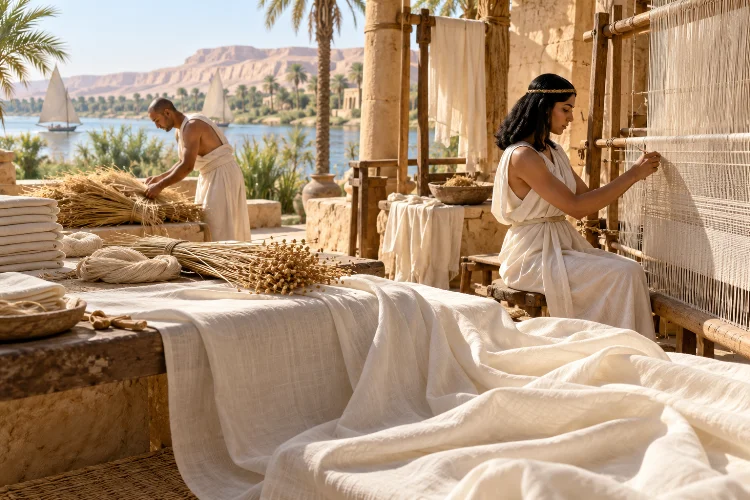
Imagine wearing a piece of fabric so finely woven that producing it could take several months of careful work.
In ancient Egypt, linen was not simply something people wore to stay comfortable. It was connected to farming, craftsmanship, wealth, religion, burial traditions, and even the power of the state.
The evolution of linen production in Ancient Egypt stretched across thousands of years.
Archaeological textile fragments from the Nile Valley date back to prehistoric periods, while sophisticated linen from later dynasties shows just how far Egyptian spinning and weaving skills eventually developed.
UCL records linen fragments from the Fayum dating to around 5000 BCE, demonstrating the remarkable age of Egypt’s textile tradition.
What began with flax cultivation and relatively simple hand processing gradually became an organised textile industry capable of producing everything from practical household cloth to exceptionally delicate royal fabric.
Following that development gives us a fascinating view of Egyptian society itself – because behind every surviving thread were farmers, spinners, weavers, officials, priests, merchants, and generations of accumulated technical knowledge.
Why Flax Became Egypt’s Essential Textile Crop
The story of Egyptian linen begins in the fields.
Linen comes from flax, or Linum usitatissimum, a plant that requires fertile soil, water, and regular care. The agricultural enviroment of the Nile Valley provided favorable conditions for growing it, particularly where annual flooding renewed agricultural land.
Archaeological evidence shows how old this relationship was. Flax seeds discovered at Badari have been dated to around 4000 BCE, while later examples from Lahun suggest changes associated with domestication.
Unlike wool, which eventually became dominant in many areas of the ancient Mediterranean and Western Asia, linen continued to hold an unusually important position in Egypt. UCL notes that most surviving textiles from dynastic and earlier Egypt are made from linen.
Flax also offered more than textile fibers. Its seeds could provide linseed oil, making the crop economically useful in several ways.
Farmers could influence the finished cloth through harvesting time as well. Younger plants could produce finer fibers suitable for delicate textiles, while more mature flax could provide coarser materals for everyday uses.
Turning Flax Stalks Into Usable Fiber
Harvesting flax was only the beginning. Transforming a plant stalk into a smooth textile required multiple stages and considerable skill.
The valuable part was the long bast fiber located between the outer skin of the flax stalk and its woody center. Ancient Egyptian workers separated these fibers while attempting to preserve their length and alignment.
According to research presented by UCL’s Digital Egypt project, Egyptian processing differed from later European methods that treated flax fibers as a loose mass.
Egyptian workers could preserve long parallel strips and divide them depending on the fineness of yarn they wanted to produce.
That distinction mattered.
Fine yarn demanded carefully prepared fibers. A worker making ordinary household cloth did not necessarily need the same precision required for lightweight garments intended for wealthy households or royal use.
Production therefore involved decisions long before a loom appeared. The quality of flax, harvesting stage, fiber preparation, and thickness of individual strips could all influence the final fabric.
It was an early example of something modern manufacturers would easily recognize: product quality begins with control over raw materials.
Spinning Methods Became Increasingly Sophisticated
Once the fibers were prepared, they had to become yarn.
Early Egyptian yarn-making did not always look like the spinning methods familiar from later textile traditions. UCL describes prehistoric Egyptian linen yarn made using a technique in which fibers could be spliced and twisted together without a spindle.
Over time, the process became more sophisticated.
During dynastic Egypt, craftspeople used what researchers describe as a “spliced and twisted” method of yarn production. Surviving textiles indicate that versions of this technique were used from roughly 3500 BCE until around 600 BCE.
Spindles increased the efficiency of yarn production. Depictions even show some Egyptian spinners handling two spindles simultaneously.
Moisture could also help when producing especially fine linen. In some cases, prepared fiber was passed through water before spinning because damp flax could be easier to handle when making delicate yarn.
These tehniques reveal an impressive understanding of material behavior. Egyptian workers did not need modern fiber science to discover how moisture, twist, fiber thickness, and tension affected yarn quality. Centuries of practical experience had already taught them.
Looms Transformed Yarn Into Egyptian Linen
Spinning created yarn; weaving transformed that yarn into usable fabric.
One of the most common structures found in ancient Egyptian textiles is plain or tabby weave, where weft threads pass alternately over and under warp threads.
Simple as the principle sounds, Egyptian weavers could create fabrics ranging from sturdy everyday cloth to extremely fine material.
The surviving evidence clearly shows technological development.
A Neolithic textile from the Fayum dating to roughly 5000 BCE has around 12 by 9 threads per centimeter. A First Dynasty garment from Tarkhan, dating to about 3000 BCE, contains roughly 24 by 15 threads per centimeter.
Later fabrics could become considerably finer.
One linen fragment associated with the mummy wrappings of Thutmose II has approximately 38 by 35 threads per centimeter, although the surviving cloth may date from a later reburial.
Thread counts cannot tell the entire history of textile quality, but they help illustrate increasing control over fine yarn and dense weaving.
Ancient Egyptian weaving also changed in organisation and scale. Household production existed alongside more structured workshops associated with estates, temples, or elite households, turning textile making into both a domestic skill and an important economic activity.
Fine Linen Became a Symbol of Wealth and Status
Not all Egyptian linen was equal.
Ordinary people needed practical clothing and household textiles, while wealthy Egyptians could access fabrics requiring much more labor and exceptionally fine yarn.
One remarkable example survives at the Metropolitan Museum of Art. A sheer linen cloth dating to the reign of Hatshepsut in the New Kingdom was produced with extraordinarily fine thread and may represent the type of fabric Egyptians described as “royal linen.”
The museum estimates that weaving such a length could have required months of constant work.
That labor helps explain its value.
A luxury textile represented hours of flax preparation, spinning, weaving, finishing, and specialised knowledge. Wearing extremely fine linen could therefore communicate social status in much the same way expensive materials and designer craftsmanship do today.
Finishing mattered as well. Untreated flax naturally tends toward a pale golden-brown shade, while washing and exposing wet linen to sunlight could make it whiter.
Ancient Egyptians also exploited the natural properties of flax to produce pleated clothing. Surviving pleated garments are known from as early as the Old Kingdom.
By the New Kingdom, elite fashion could feature increasingly elaborate folds, transparent fabrics, fringes, and carefully arranged layers.
Linen Was More Than Clothing
One reason linen became so important is that Egyptians used it for far more than everyday garments.
Cloth served as bedding, sacks, household material, temple offerings, ceremonial garments, and valuable property. Large quantities could be stored and redistributed through institutions connected with temples, estates, and royal administration.
Its religious role was particularly significant.
Clean linen became associated with purity, making it suitable for priests and ritual activities. It was also central to Egyptian funerary practices.
Bodies prepared for burial were wrapped with enormous quantities of linen. Different strips and sheets could be used during the mummification process, sometimes alongside oils and resins.
The earliest Egyptian funerary texts even identify linen among important offerings for the deceased, while surviving high-quality sheets demonstrate that valuable cloth could accompany elite burials.
Reusing fabric was also practical. Some funerary linen appears to have had a previous life as clothing or household textile before becoming mummy wrapping.
This combination of practical, commerical, symbolic, and religious uses created continuous demand for textile production across Egyptian society.
What Surviving Linen Reveals About Egyptian Innovation
Ancient textiles are unusually valuable archaeological evidence because cloth is normally difficult to preserve.
Egypt’s dry climate allowed examples to survive that would have disappeared almost completely in wetter environments. Researchers can examine thread direction, weaving density, fringes, seams, fiber quality, and spinning methods to reconstruct how fabrics were produced.
A British Museum linen fragment dated broadly to the New Kingdom or Third Intermediate Period, for example, preserves a plain warp-faced weave with approximately 24 warp threads and 16 weft threads per centimeter.
Tiny technical details like these allow archaeologists to trace production traditions over long periods.
More importantly, they remind us that ancient technology was not limited to monuments, metals, or weapons. Producing fine linen required agricultural knowledge, specialized tools, manual precision, organised labor, and sophisticated understanding of natural fibers.
The pyramids may dominate popular images of ancient Egypt, but textiles reveal another kind of engineering – one built from fibers rather than stone.
The evolution of linen production in Ancient Egypt reflects thousands of years of experimentation, craftsmanship, and economic development.
Egyptian workers turned flax from Nile Valley fields into yarn, everyday clothing, sophisticated pleated garments, religious textiles, and exceptionally fine fabrics worthy of royal households.
Improvements in fiber preparation, spinning, weaving, and finishing gradually made linen one of ancient Egypt’s most recognizable products. At the same time, its role in temples, fashion, households, and mummification made cloth deeply connected with Egyptian cultural identity.
Surviving linen fragments may look modest beside monumental temples and tombs, yet they preserve an equally fascinating story of human innovation.
When exploring ancient Egypt, look beyond its famous stone monuments. Sometimes a fragile thread can tell us just as much about how an ancient civilization actually lived.