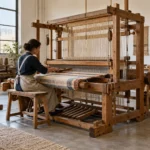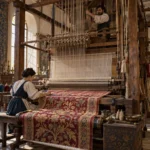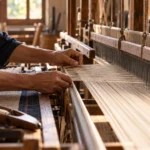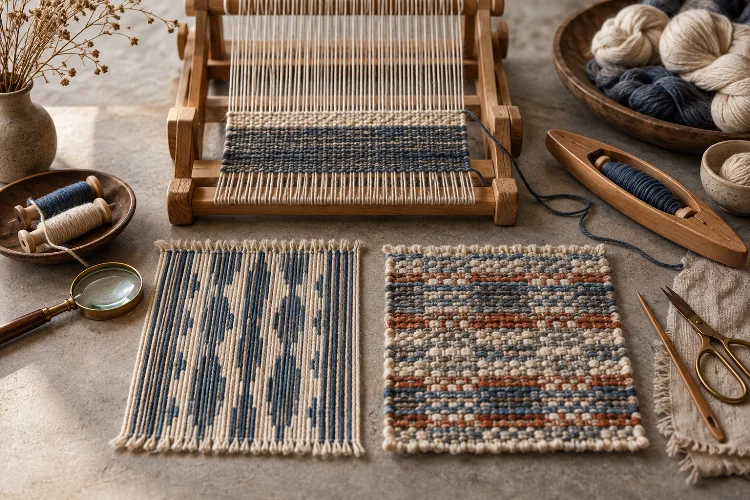
At first glance, a patterned textile may simply look like a collection of colors, stripes, geometric shapes, or decorative motifs. Look more closely, however, and the direction of the threads can reveal exactly how the design was built.
This is where the difference between warp and weft patterning becomes important.
Warp threads run lengthwise on a loom and are placed under tension before weaving begins. Weft threads travel across those warps during the weaving process.
Depending on which set of threads dominates the design, a craftsperson can produce dramatically different visual and structural results.
The technical differences between warp and weft patterning influence everything from loom preparation and tension control to color placement, motif flexibility, and production speed.
Techniques such as warp-faced weaving, tapestry, supplementary weft, and ikat all use these relationships differently.
Understanding those differences does more than help identify historic textiles. It also reveals how weavers transform two simple thread systems into highly sophisticated surfaces using surprisingly precise planning.
Warp and Weft Perform Different Structural Jobs
Every conventional woven textile begins with two directions of yarn.
The warp is the group of threads stretched lengthwise through the loom. These threads remain under tension throughout much of the weaving process.
The weft crosses from side to side.
As the loom raises and lowers different groups of warp threads, a temporary opening called the shed appears. The weft passes through that opening and becomes locked into the structure when the warp changes position.
This relationship sounds basic, but pattern formation depends heavily on which thread system becomes visually dominant.
In a balanced plain weave, warp and weft may appear in roughly similar proportions. Neither system completely hides the other.
Warp-faced and weft-faced textiles behave differently.
In a warp-faced structure, warp threads are packed closely enough that they dominate the visible surface. In weft-faced weaving, the horizontal wefts are packed so densely that they hide most or all of the underlying warp.
A Chimú textile held by The Metropolitan Museum of Art demonstrates this clearly: tightly packed horizontal yarns cover the warp almost completely, producing a weft-faced surface.
That basic distinction becomes the foundation for more complicated patterning.
Warp Patterning Is Often Planned Before Weaving Begins
Warp-dominant designs usually require significant preparation before the first weft is inserted.
The weaver decides the order, color, and sometimes structural behavior of individual warp threads while dressing the loom.
Simple stripes are a good example.
If groups of red, white, and blue warp yarns are arranged in repeating sections, vertical stripes appear naturally once weaving begins. The pattern is essentially stored in the warp arrangement.
This can make production relatively efficient after setup, but it also reduces the ability to change the basic design halfway through weaving.
Warp-faced traditions often exploit this characteristic.
Aymara textiles from the Andean region use fine camelid yarns and sophisticated color arrangements to create visually strong stripes and other longitudinal effects.
The Metropolitan Museum of Art describes warp-faced weaving as a longstanding Aymara tradition with roots extending into pre-Hispanic textile culture.
The main tecnical challenge is preparation.
Warp order must be accurate, tension should remain even, and individual threads need to maintain their intended position. A mistake during warping can continue through a large section of finished cloth.
Weft Patterning Gives the Weaver More Design Flexibility
Weft-controlled design develops differently because decorative yarn is introduced progressively while weaving.
This often gives the craftsperson greater freedom to modify motifs row by row.
Tapestry is one of the clearest examples.
In a weft-faced tapestry, tightly packed colored wefts cover the structural warp. Different colored wefts may be used only in specific areas rather than travelling across the entire width.
That technique makes it possible to create figures, plants, animals, geometric forms, and pictorial scenes.
A medieval German tapestry in The Metropolitan Museum of Art, for example, uses a discontinuous weft-faced plain weave in which dyed wool and metal-thread wefts cover an underlying linen warp.
The warp essentially becomes the hidden skeleton.
Because the image is constructed with successive weft insertions, the weaver can control relatively small areas independently.
However, that flexibility often requires more labor.
Each color area may need a seperate yarn source, and the weaver must carefully manage boundaries where two colors meet.
Warp patterning frequently emphasizes repetition along the loom’s length, while weft patterning can make it easier to build horizontal or pictorial information gradually.
Supplementary Threads Add Patterns Without Replacing the Ground
Not every decorative design needs to be part of the primary structural weave.
Supplementary patterning introduces additional yarn specifically for decoration.
A supplementary weft, for example, travels across selected areas of the textile while a separate ground weft maintains the main fabric structure.
The extra yarn may float over several warp threads before being secured again.
This creates raised geometric shapes, symbols, animals, or decorative bands without forcing the entire fabric to follow the same structure.
Traditional West African textiles provide excellent examples.
A Smithsonian National Museum of African Art wrapper woven from narrow strips contains supplementary weft motifs representing forms such as leaves, keys, squares, and lozenges.
Asante kente can combine both approaches within the same strip.
The Met describes one prestige cloth as having a slightly warp-faced foundation combined with extra weft-faced patterning. Another example juxtaposes vertical warp-face patterns with horizontal geometric weft-face designs.
This combination shows why “warp versus weft” is not always an either-or distinction.
Advanced textiles can deliberately manipulate both systems to produce layered visual effects.
Warp Ikat Stores the Pattern in the Loom Before Weaving
Ikat makes the differences between warp and weft patterning particularly easy to understand.
In ikat, yarns are resist-dyed before they are woven.
Selected areas are tightly bound so dye cannot reach them. After dyeing, the bindings are removed, revealing prearranged colored sections along the thread.
In warp ikat, this process happens to the warp yarns.
The Australian Museum describes warp ikat as the oldest and most common major form of the technique. Groups of warp threads are bundled, resist-bound, dyed, and later arranged on the loom so their colored sections align into a planned design.
Because the design already exists in the warp, alignment during loom setup is critical.
If one group is stretched differently or positioned incorrectly, parts of the image shift.
Warp tension therefore becomes part of pattern control.
Once weaving begins, the weft often serves mainly to stabilize the structure and reveal the pattern already encoded in the longitudinal yarns.
The result can include vertical visual movement and the characteristic slightly blurred edges associated with many ikat textiles.
Weft Ikat Requires Continuous Pattern Alignment
Weft ikat reverses the logic.
Instead of patterning the threads stretched on the loom, the resist-dyed design is carried by the yarn travelling horizontally across the fabric.
This creates a different production challenge.
Each section of patterned weft needs to arrive in approximately the correct location as it passes through the warp.
The Australian Museum explains that Balinese weft-ikat textiles require the weaver to carefully adjust the weft after each pass so that the pattern remains recognizable and properly aligned.
That can make production slower.
With warp ikat, much of the alignment is established when the loom is prepared. With weft ikat, alignment may require constant attention throughout weaving.
If the weft is pulled too far to one side, the motif shifts.
If it is not pulled far enough, another distortion appears.
The craftsperson therefore becomes an active pattern-adjustment system throughout the process.
This is one reason high-quality weft ikat can require extraordinary patience and consistant control.
Double Ikat Combines Both Pattern Systems
Double ikat takes the challenge even further.
Both warp and weft are resist-dyed with predetermined designs before weaving.
During production, the two sets of patterned threads must align with one another to form the intended image.
The Australian Museum describes double ikat as the rarest major ikat method and points to textiles such as Gujarati patola and Balinese geringsing as important examples.
The technical difficulty is enormous.
Imagine creating half of an image vertically and another half horizontally before the threads ever enter the loom.
Those two systems must then meet accurately during weaving.
Slight differences in yarn stretch, tension, placement, or beating can move part of the motif.
For this reason, double ikat reveals one of the most important lessons in textile engineering: pattern is not simply applied to cloth.
In many traditions, pattern is built into the physical relationship between threads.
Pattern Direction Changes the Appearance of the Fabric
Warp and weft patterning also influence how the eye reads a textile.
Warp-controlled designs naturally emphasize the length of the cloth. Vertical bands, narrow stripes, and repeated longitudinal arrangements can make fabric appear visually elongated.
Weft-dominant designs emphasize the crosswise direction.
Because each new row can introduce another color or motif section, weft patterning works particularly well for tapestry-style imagery, horizontal bands, and detailed figurative designs.
Yet skilled weavers regularly disrupt these expectations.
Supplementary wefts can create isolated motifs against strongly vertical warp stripes. Warp color sequences can interact with changing weft colors to produce checks or plaid-like designs.
An Akwete textile in The Met’s collection shows how differently colored warp and weft yarns can work together in carefully planned ratios to produce checked and plaid structures, while other Akwete textiles commonly use supplementary weft motifs over a warp-faced ground.
The final appearance therefore depends not simply on thread direction but on density, color, floats, yarn thickness, and interlacement.
That is why textile analysis can become surprisingly complex.
How to Recognize Warp and Weft Patterning
You do not always need laboratory equipment to begin identifying how a fabric was patterned.
Start by determining the thread directions.
The warp generally runs parallel to the long direction in which the fabric was woven, while the weft travels between the selvedges.
Next, look at which threads dominate the surface.
If tightly packed longitudinal yarns hide much of the crosswise thread, the fabric may be warp-faced. If horizontal yarns almost completely cover the warp, it is probably weft-faced.
Then examine the motif.
Does the design seem embedded in the vertical thread arrangement? That may indicate warp patterning.
Does the decoration consist of horizontal floats or small motifs sitting on top of a simpler ground fabric? Supplementary weft is a strong possibility.
With ikat, the blurred boundaries can provide additional clues. Warp ikat tends to show pattern information carried along the lengthwise yarns, while weft ikat distributes it across horizontal picks.
Historic textiles can combine several methods, however, so identification is not always simple.
The most interesting fabrics often resist neat categories.
Why the Difference Matters in Textile History
Understanding warp and weft patterning helps historians reconstruct how textiles were made.
A surviving fabric contains evidence about the loom, production sequence, labor requirements, and skill of its maker.
Warp-dominant designs can reveal careful planning before weaving. Weft-controlled imagery may demonstrate intensive manipulation during production.
Supplementary structures can show how decorative effects were added without changing the ground fabric, while ikat reveals sophisticated mathematical thinking about pattern placement before the yarn even reached the loom.
These techniques also influenced trade and cultural identity.
A particular structure could become associated with one region, community, or ceremonial tradition. When similar weaving methods appear far away, researchers can investigate whether technologies moved through migration, trade, imitation, or independent invention.
Thread direction therefore becomes historical evidence.
A tiny structural difference invisible to most viewers can help explain how people organized labor, understood design, and transferred textile knowledge between generations.
The technical differences between warp and weft patterning begin with thread direction but extend much further.
Warp-controlled designs are often planned during loom preparation, while weft patterning can give craftspeople greater freedom to develop imagery as weaving progresses.
Warp-faced structures, tapestry, supplementary wefts, and ikat each exploit these systems differently. Double ikat pushes the relationship to an extreme by requiring pre-patterned warp and weft threads to meet precisely in the same textile.
Learning to recognize these structures changes the way you look at woven cloth.
Instead of seeing only color and decoration, examine which threads are visible, where they travel, and how they interact. Those details reveal the hidden engineering behind the design—and the remarkable knowledge of the people who created it.