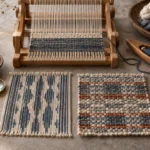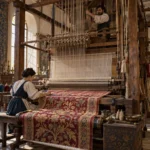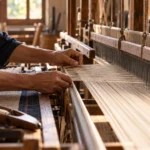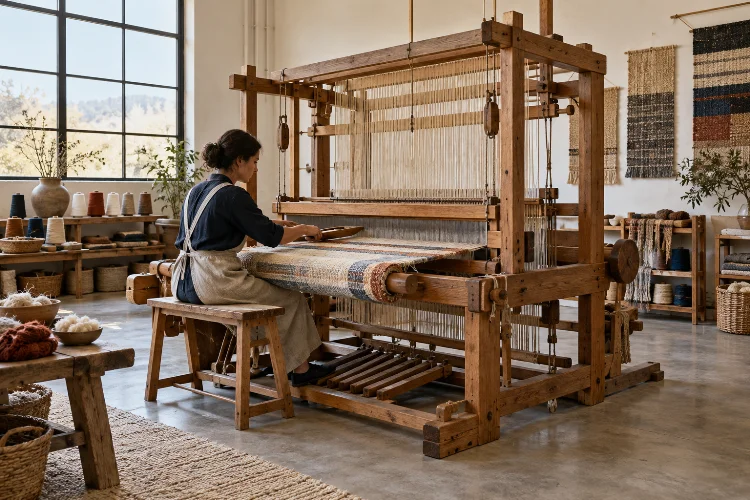
A traditional floor loom can look intimidating when you first see one. There are wooden beams, dozens or hundreds of warp threads, moving shafts, foot pedals, heddles, and a heavy beater all working together.
Yet once you understand the system, the machine becomes surprisingly logical.
Traditional floor looms transform simple threads into structured cloth by carefully controlling which warp threads rise or fall during every pass of the weft.
That basic idea can produce everything from plain everyday fabric to diagonal twills, textured patterns, complex geometric designs, and highly decorative textiles.
What makes these looms especially fascinating is the relationship between mechanical design and human skill. The loom stores part of the weaving instructions, but the craftsperson still controls rhythm, tension, beating force, color placement, and pattern sequencing.
Understanding how traditional floor looms produce intricate textile structures therefore offers a window into centuries of textile engineering.
Long before automated factories, handweavers had already developed remarkably sophisticated systems for turning repeated movements into complex, durable, and beautiful cloth.
How a Traditional Floor Loom Is Organized
Most floor looms follow the same basic pathway.
Warp yarn begins at a warp beam at the back of the loom. The threads travel forward through heddles mounted inside shafts, pass through the reed, cross the weaving area, and eventually wind onto the cloth beam at the front.
A modern explanation of floor loom anatomy identifies components including the warp beam, shafts, heddles, beater, reed, breast beam, cloth beam, treadles, and the tie-up system connecting treadles to shafts.
Each element has a specific job.
The warp beam stores unwoven yarn. Heddles guide individual warp ends. Shafts group those heddles together. Treadles allow the weaver to move particular shafts with their feet.
The reed performs two important functions. It keeps warp threads evenly spaced and is mounted in the beater so the weaver can push each newly inserted weft into position.
The real sophistication comes from coordination.
Instead of controlling each thread individually, a floor loom organizes warp threads into groups. The weaver can then manipulate hundreds of threads through a relatively small number of mechanical actions.
Heddles and Shafts Create the Basic Structure
Heddles are among the most important parts of a handloom.
Each warp thread passes through an eye in a heddle. Those heddles sit inside frames called shafts or harnesses.
When a shaft moves upward or downward, every warp thread attached to it moves too.
This creates the shed—the temporary opening through which a shuttle carrying the weft travels.
A simple two-shaft loom can produce plain weave. One group of warp threads rises while the other remains below, then their positions reverse on the next pick.
Add more shafts and the possibilities expand dramatically.
Four shafts, for example, allow a weaver to organize warp threads into more complex sequences suitable for many twill structures.
The Science Museum Group notes that four heddle groups can support weaving twill and related patterns, demonstrating how changing which groups rise and fall alters the finished structure.
Traditional weavers therefore use shaft arrangements almost like structural instructions.
The order in which warp threads are threaded through heddles helps determine what patterns can appear later.
Treadles Turn Foot Movement Into Pattern Control
One major technological advance in loom development was the introduction of treadles.
Instead of using the hands to lift heddles manually, a weaver could press pedals with their feet while keeping both hands available to manage the shuttle and beater.
The China National Silk Museum describes treadle-operated shedding as an important development in loom history. Early Chinese treadle looms allowed foot movement to operate heddles, making repeated shed changes faster and more efficient.
The principle remains central to traditional floor looms.
Each treadle connects to one or more shafts through cords, lams, or another mechanical tie-up system.
On a countermarch floor loom, for example, pressing a treadle can actively lower selected shafts while raising the others. Museums Victoria documents this arrangement on a traditional countermarch loom used to weave Latvian patterns.
Different treadle combinations create different sheds.
This means a weaver can effectively “program” a recurring sequence using their feet.
A basic rhythm might involve only two treadles. A complicated pattern may require many more combinations repeated in a carefully memorized order.
That foot-controlled system allows intricate weaving without interrupting the flow of production.
Plain Weave, Twill, and Other Structures Come From Sequencing
The visible appearance of a woven textile depends heavily on how warp and weft intersect.
Plain weave is the simplest example.
One weft passes over one warp and under the next, alternating across the fabric. On the following row, the sequence reverses.
Twill works differently.
Instead of alternating every thread, intersections shift gradually across successive rows. That creates the familiar diagonal lines found in many woven fabrics.
A floor loom with multiple shafts makes these sequences much easier to repeat consistently.
The weaver may thread warp yarn through shafts in a particular order – such as a sequence progressing across four shafts – and then follow a treadling pattern that determines which shafts move on each pick.
Change either sequence and the pattern changes.
Satin-type structures similarly depend on distributing intersections so long stretches of yarn remain visible on the fabric surface.
The important point is that intricate textiles do not usually require the weaver to manipulate every thread individually.
Complexity emerges from organized repetition.
This is one reason floor looms are so powerfull: relatively simple mechanical movements can generate visual structures that appear much more complicated.
Warp Tension and Beating Determine Fabric Quality
A perfect treadling sequence will not produce good cloth if warp tension is unstable.
Warp threads must remain under controlled and reasonably consistent tension as they travel through the loom.
Too loose, and the shed may not open clearly. Too tight, and fragile yarn can break or become difficult to manipulate.
Once the weft passes through the shed, the beater moves forward.
The reed then pushes—or “beats”—the weft into the growing fabric.
This action influences fabric density.
If a weaver beats aggressively, weft threads may pack tightly together. A lighter beat creates a more open structure.
Traditional floor loom weaving therefore involves constant coordination between tension, shed opening, shuttle movement, and beating force.
Experienced weavers develop a predictable rhythm.
Press treadle. Open shed. Throw shuttle. Catch shuttle. Beat. Change treadle. Repeat.
When that rhythm becomes consistent, the fabric usually becomes more uniform as well.
Small mistakes can create visible changes in density, edge width, or pattern alignment, which is why experienced handweavers pay so much attention to details that casual observers may barely notice.
Multiple Shafts Expand Pattern Possibilities
Adding shafts dramatically increases what a floor loom can do.
Two shafts primarily support simple alternation. Four shafts allow a much wider variety of twills and related structures.
Eight, twelve, sixteen, or more shafts can produce increasingly complicated patterns.
Historic weaving traditions developed this principle much further.
The China National Silk Museum describes multi-heddle and multi-treadle pattern looms in which numerous heddles and treadles stored patterning information. Some Chinese pattern looms used dozens of lifting shafts to control decorative designs.
One documented Dingqiao pattern loom could have around 2–8 shafts for the ground structure while using roughly 40-60 lifting shafts for the decorative pattern.
That sounds remarkably complicated because it was.
The loom essentially translated a pattern plan into groups of mechanical thread movements.
More shafts meant more possible combinations, but also more setup work and a greater need for accuracy.
This helps explain why elaborate historic textiles were expensive.
Their value represented not just luxurious fibers but immense investments of planning, threading, specialised knowledge, and labor.
Traditional Floor Looms Increased Weaving Speed
Floor looms did more than increase pattern complexity.
They also improved efficiency.
In Guatemala, treadle looms were introduced after the Spanish conquest and came to exist alongside older backstrap weaving traditions.
The Sam Noble Oklahoma Museum of Natural History explains that both systems rely on raising and lowering warp threads, but treadle looms use foot pedals to control that movement mechanically.
As a result, weaving can proceed significantly faster than on a loom where heddles must be manipulated primarily by hand.
This division of labor across the body matters.
The feet operate the shafts. The hands manage the shuttle and beat. The eyes monitor the emerging textile.
Because several operations become coordinated, skilled weavers can maintain a continuous rhythm.
Floor looms can also accommodate wider cloth than many portable weaving systems.
That made them particularly useful for commercial workshops producing yardage for garments, furnishings, and trade.
Efficiency did not eliminate craftsmanship, however.
The machine increased what a skilled person could accomplish, but quality still depended heavily on the weaver.
Narrow-Band Loom Traditions Show Another Approach
Not every traditional treadle loom was designed to produce broad fabric.
In parts of West Africa, narrow-band looms developed highly sophisticated textile traditions.
The Metropolitan Museum of Art describes Baule and Guro weaving systems in which heddle pulleys help heddles move smoothly as warp layers separate and allow the shuttle to pass through.
These looms produce relatively narrow strips of fabric.
The strips can later be sewn together to create larger textiles.
This demonstrates that loom technology does not follow a single evolutionary path where larger always means better.
Different cultures optimized weaving systems according to local materials, working environments, garment traditions, and aesthetic preferences.
Even practical components could become art objects.
West African heddle pulleys were sometimes beautifully carved with human or animal forms, blending mechanical function with artistic expression.
The weaving equipment itself became part of visual culture.
Floor Looms Can Preserve Cultural Identity
Traditional looms do more than manufacture cloth.
They can also preserve cultural memory.
Museums Victoria holds a countermarch floor loom made for Latvian weaver Anna Apinis after World War II while she was living in a displaced persons camp in Germany.
The loom was constructed from salvaged timber taken from bomb-damaged buildings. Apinis used it to weave both traditional and experimental Latvian designs before eventually taking the loom to Australia and teaching weaving to her daughter.
That story shows how textile technology can travel with people.
Patterns, threading sequences, color combinations, and loom techniques may survive even when communities move thousands of kilometers from their original homes.
A floor loom therefore acts partly as a cultural storage system.
The wooden frame holds the threads, but the weaver holds the knowledge.
Without that human knowledge, the loom is simply equipment. When techniques continue to be taught, it becomes a bridge between generations.
Why Traditional Floor Looms Still Matter
Modern industrial machines can weave fabric at speeds historic handweavers could never match.
Yet traditional floor looms remain valuable because they expose the underlying logic of textiles.
A handweaver can see exactly how changing one shaft sequence affects a twill line, how tension changes density, or how treadling order transforms a pattern.
There is very little technological mystery.
The structure of the cloth is visible as it develops.
Traditional looms also demonstrate an important principle of engineering: complicated results do not always require complicated individual actions.
A pattern may contain hundreds of visual elements, yet each pick is created through a relatively straightforward sequence of lifting threads, inserting weft, and beating it into place.
What creates sophistication is repetition, organization, and control.
That principle links traditional weaving with later mechanical and even digital systems.
Traditional floor looms produce intricate textile structures by coordinating warp threads through heddles, shafts, treadles, reeds, and carefully controlled tension.
Simple changes in threading and treadling can transform plain weave into twills, geometric patterns, textured surfaces, and highly sophisticated decorative cloth.
More shafts create greater pattern possibilities, while foot-operated controls allow skilled weavers to work efficiently without sacrificing precision.
Yet the loom is only part of the technology. The craftsperson still controls rhythm, beating force, tension, color, and countless small decisions that determine the final fabric.
If you want to understand woven textiles more deeply, study a traditional loom in operation. Watching threads repeatedly rise, separate, cross, and lock together makes it clear that even the most intricate cloth begins with a surprisingly elegant mechanical idea.