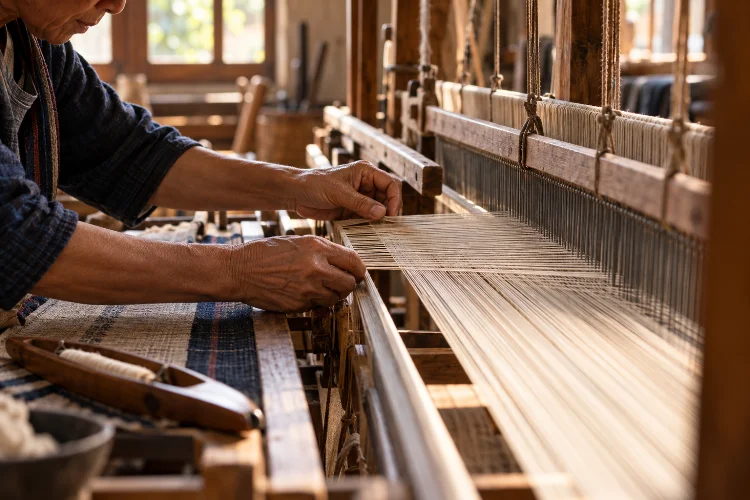
Watch an experienced handloom weaver for a few minutes and the process can look almost effortless. The shuttle moves across the loom, the beater pushes each new thread into place, and slowly a perfectly structured piece of fabric appears.
Behind that smooth rhythm, however, is one of weaving’s most important technical challenges: tension.
Warp tension control in traditional handloom weaving determines how firmly the lengthwise threads are held while the weft passes between them. Too much tension can make fragile yarn snap.
Too little can create an unstable shed, irregular edges, and loose fabric. Even small differences between groups of warp threads can eventually become visible in the finished cloth.
Traditional weavers learned to manage this problem long before mechanical tension systems existed. Some relied on beams and weights, while backstrap loom weavers literally used their bodies to regulate the warp.
Understanding these methods reveals something important about hand weaving: good cloth depends not only on beautiful patterns, but also on controlling invisible forces throughout the entire weaving process.
What Is Warp Tension in Handloom Weaving?
Warp threads run lengthwise through woven fabric. Before weaving begins, these threads are arranged on the loom and placed under tension so they remain reasonably straight and stable.
The weft travels across them.
Ideally, warp tension should be even enough that the threads respond consistently whenever the weaver opens a shed or beats a new pick of weft into position.
This does not mean the warp must be stretched as tightly as possible.
More tension is not automatically better. The correct amount depends on yarn strength, loom design, fabric structure, weaving technique, and the density the craftsperson wants to achieve.
Cotton yarn may respond differently from wool, silk, linen, or plant fibers such as abaca. A delicate yarn placed under excessive force may repeatedly break, while a stronger yarn may tolerate significantly firmer tension.
The real goal is therefore controlled tension rather than maximum tension.
That distinction is one of the first principles a traditional weaver learns through experience.
Why Even Warp Tension Matters
Uneven tension creates a chain reaction.
Imagine one group of warp threads is slightly tighter than the rest. Those threads resist movement more strongly, while neighboring threads may remain loose or sag.
The shed – the temporary opening through which the weft passes – can then become uneven.
A poorly formed shed makes shuttle movement harder and increases the possibility of catching the wrong threads. The problem may seem small at first, but repeated over hundreds of picks it can distort the finished textile.
Uneven tension can also affect fabric density.
When the warp is stable, the weaver can beat successive weft threads into position with relatively consistent force. If portions of the warp constantly shift, the same beating motion may produce different spacing across the cloth.
Edges can suffer as well.
Selvedges may draw inward, expand outward, or become wavy. A fabric that looked reasonably balanced on the loom can reveal those problems more clearly after it is removed and allowed to relax.
Maintaining consistency is therefore not simply about making weaving easier. It determines the structure of the finished cloth.
Backstrap Looms Turn the Weaver Into the Tensioning System
Few traditional technologies demonstrate warp tension control more clearly than the backstrap loom.
One end of the warp is attached to a fixed point such as a tree, post, or house structure. The opposite end is connected to a strap around the weaver’s body.
The Australian Museum explains that the weaver can adjust warp tension simply by leaning forward or backward. Leaning back increases tension, while changing body position allows the warp to relax when needed.
This design makes the body part of the machine.
The Sam Noble Oklahoma Museum of Natural History describes the same principle in traditional Maya weaving: the back belt connects the weaver directly to the loom, allowing tension to be controlled continuously through movement.
That creates an unusual level of sensitivity.
An experienced weaver can feel whether the warp is becoming too loose or too tight. Instead of turning a mechanical adjustment, they may correct it almost instinctively through posture.
This embodied technique helps explain why traditional weaving expertise can be difficult to learn from instructions alone. Some knowledge is stored in physical repetition rather than written formulas.
Frame Looms Control Tension in a Different Way
Frame and shaft looms separate the weaver’s body from much of the tensioning process.
Instead of relying on posture, warp threads are generally stretched between beams or other structural parts of the loom.
The Australian Museum notes that frame looms allow the beams themselves to regulate warp tension, eliminating the need for a backstrap. These looms also supported faster production and wider textiles in some Indonesian weaving traditions.
This changes the weaver’s relationship with the warp.
Once the threads are correctly prepared and wound, the loom can maintain a relatively stable working tension. The weaver periodically advances the cloth and releases additional warp as production continues.
However, mechanical control does not eliminate tension problems.
The warp must still be wound evenly. Threads passing through heddles and reeds must follow consistent paths, and any damaged or incorrectly prepared yarn can behave differently from its neighbors.
In other words, a larger loom may reduce the need for continuous body-controlled adjustment, but careful preparation remains essential.
Tension Determines How Cleanly the Shed Opens
The shed is one of the most important spaces in weaving, even though it exists only temporarily.
When alternate groups of warp threads are separated, an opening appears. The shuttle or weft carrier passes through this space before the threads change position again.
A backstrap loom uses tools such as shed rods, heddle rods, and battens to control this process. The Sam Noble Museum explains that the heddle rod lifts alternate warp threads while other loom components preserve their crossing and help create space for the weft.
Tension determines how clearly that separation happens.
If the warp is too loose, threads may hang irregularly and obstruct the shuttle. If it is excessively tight, lifting the heddles can require unnecessary force and place additional stress on the yarn.
The best tension creates a clean shed without overloading the fibers.
This balance becomes especially important in complex weaving where supplementary wefts, brocade structures, or carefully positioned decorative threads must pass through selected areas.
Small differences in tension can determine whether a detailed design appears crisp or irregular.
Warp Tension Influences Beat and Fabric Density
After the weft passes through the shed, it has to be moved into position.
Traditional weavers may use a batten, weaving sword, or beater to pack the new weft against the existing fabric. The Sam Noble Museum notes that the batten used with Maya backstrap looms can both help separate warp threads and tighten the weft after insertion.
But beat alone does not determine density.
Warp tension and beat work together.
Imagine beating the same yarn with exactly the same force under two different tension conditions. A relaxed warp can shift significantly, allowing the weft to pack differently than it would against a firmly tensioned warp.
This affects the number of threads occupying a given area of fabric.
For this reason, experienced handweavers often develop a rhythm where tension, shed opening, shuttle movement, and beating become interconnected actions rather than separate tasks.
Consistency is the goal.
Constantly changing tension while using the same beat can create visible bands where some areas are denser than others.
Learning to maintain that rhythm is one of the less obvious skills behind professional-looking handwoven cloth.
Traditional Ikat Makes Tension Control Even More Important
Warp tension becomes particularly interesting in ikat weaving.
In warp ikat, yarns are resist-dyed before weaving begins. The individual colored sections must then be positioned carefully so they combine into the intended visual pattern.
The Australian Museum explains that slight difficulties in aligning these pre-dyed threads often produce the characteristic soft or blurred appearance associated with ikat. Highly skilled weavers can achieve exceptionally precise alignment.
Tension influences that alignment.
If one group of threads is stretched differently from another, previously planned colored sections can move out of position.
This means an ikat weaver is managing both fabric structure and imagery at the same time.
The problem becomes even more challenging with double ikat, where both warp and weft threads contain pre-arranged dyed patterns.
Producing a recognizable motif demands careful preparation, tension control, and repeated adjustment throughout weaving.
What looks like decorative art is therefore also a technical exercise in precision.
Selvedges Reveal Tension Mistakes Quickly
The edges of handwoven fabric often reveal how well tension and weft placement have been controlled.
When a weaver pulls each weft pass too tightly, the textile begins narrowing. The outer warp threads are pulled inward and may experience greater stress than threads in the center.
Pull too loosely and the opposite problem appears.
Loops may form along the selvedges, creating an uneven edge.
Consistent tension helps, but the weaver must also understand how much weft the fabric requires before beating.
Traditional artisans usually develop this judgement through repeated practise. They observe how a particular fiber behaves, how much it contracts, and how strongly it responds to changes in tension.
The correct technique may even change during the same textile if yarn thickness or decorative structure changes.
That is why perfectly straight handmade selvedges are often a sign of considerable expertise.
They show that the weaver has successfully coordinated several variables over hundreds or thousands of repeated movements.
Traditional Weaving Shows That Tension Is an Embodied Skill
Handloom tension control is difficult to reduce to a single numerical formula.
Modern textile equipment can measure forces precisely, but traditional craftspeople often work through touch, sight, sound, and accumulated experience.
The Textile Museum of Canada describes a T’boli backstrap loom in which the weaver attaches the unfinished end to a belt around the body and leans backward to generate the tension required for weaving.
The design is portable enough to be rolled up and stored when not in use. A skilled weaver gradually learns what correct tension feels like.
They recognize the resistance of the heddle, the sound produced when the weft is beaten, the visual straightness of the warp, and subtle changes in the cloth edge.
This is why traditional handloom weaving represents more than simple equipment.
The technological system includes the loom, yarn, tools, body movement, and the craftsperson’s judgement.
Remove that learned judgement and even a perfectly constructed loom may produce poor fabric.
Understanding warp tension control in traditional handloom weaving reveals how much technical knowledge sits behind seemingly simple handmade fabric.
Stable tension supports clean sheds, predictable beating, consistent fabric density, strong selvedges, and accurate decorative patterns.
Different looms solve the challenge in different ways. Backstrap weavers regulate tension directly through body movement, while frame looms rely more heavily on beams and structural mechanisms.
In both cases, however, successful weaving still depends on experience and careful observation.
This is what makes traditional handweaving so valuable to study. The loom may be simple, but the knowledge required to operate it is remarkably sophisticated.
Next time you examine a handwoven textile, look closely at its edges, density, and pattern alignment. Those small details reveal how successfully the weaver controlled every thread under tension.