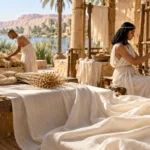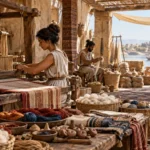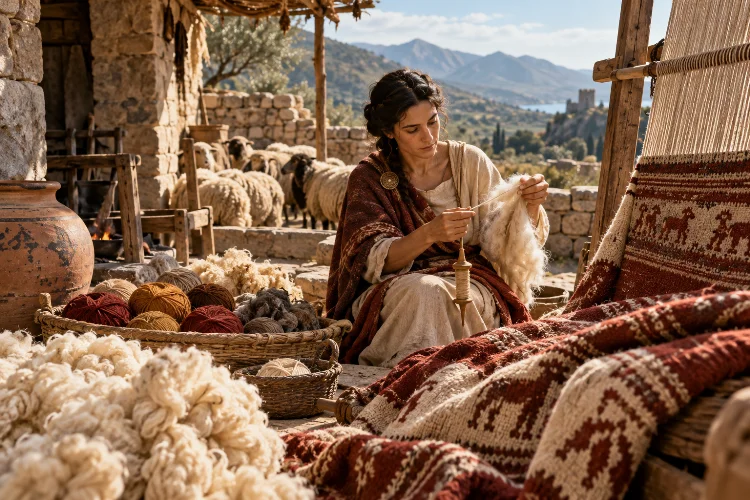
A piece of wool clothing might seem ordinary today, but in the ancient world it could represent months of labor, valuable livestock, family wealth, religious identity, and even political authority.
Before industrial textile production, every stage had to be done manually. Sheep needed to be raised, fleece collected and cleaned, fibers prepared, yarn spun, dyes produced, and cloth woven on a loom.
Because so much work was involved, wool textiles often carried meanings that went far beyond keeping people warm. The cultural significance of wool textiles in ancient societies can be seen from Mesopotamia and Anatolia to Greece, Rome, and Iran.
Wool became an important trade commodity, a marker of social position, a household responsibility, and a medium through which communities expressed artistic ideas.
The Metropolitan Museum of Art notes that animal fibers, particularly wool, have historically been used for everything from clothing to rugs.
Following the history of wool therefore offers a surprisingly detailed look at how ancient people worked, traded, worshipped, dressed, and understood their place in society.
Wool Helped Build Early Urban Economies
One of the clearest examples of wool’s economic importance comes from ancient Mesopotamia.
The environment surrounding southern Mesopotamian cities provided extensive grazing areas for sheep and goats. Their fleece supplied raw materials that urban workers could transform into textiles ranging from simple everyday cloth to much finer fabrics.
By the end of the fourth millennium BCE, textile production had become one of southern Mesopotamia’s most important manufactured industries.
Penn Museum research describes how large groups of workers produced more textiles than local populations required, allowing cloth to be exchanged for resources such as metals and valuable stones that Mesopotamia lacked.
This makes wool much more than an ancient clothing material.
It became part of an early econmic system connecting pastoralism, agriculture, urban workshops, administration, and long-distance commerce.
Managing large herds and textile workforces also encouraged institutions to keep detailed records of animals, workers, rations, and manufactured goods.
In that sense, wool helped support the increasingly complex systems behind some of the world’s earliest cities.
Wool Clothing Became a Visible Sign of Status
Ancient clothing could immediately communicate someone’s position in society.
Not all wool was equal. Differences in the quality of fleece, spinning, weaving, color, decoration, and finishing could dramatically change the value of a garment.
In ancient Near Eastern art, sheep’s wool appears in several recognizable forms of elite dress.
The Metropolitan Museum of Art describes woolen garments shown in Sumerian and Akkadian art during the third millennium BCE, while later Near Eastern robes could include fringed borders, woven designs, embroidery, and decorative metal elements.
Producing elaborate clothing required significantly more labor than producing a basic garment.
Fine yarn took skill to spin. Strong dyes could require expensive materials and specialist knowledge, while complex decorative weaving demanded experienced craftspeople.
The wearer was therefore displaying more than personal taste. A high-quality wool garment could indirectly advertise access to livestock, labor, skilled artisans, trade networks, and wealth.
Much like luxury fashion today, ancient textiles could turn material quality into visible social prestiege.
Wool Working Shaped Women’s Roles in Ancient Greece
Wool textiles were also deeply connected with gender and household organization.
In Classical Greece, spinning and weaving were strongly associated with women. The Metropolitan Museum of Art explains that fabric production and household management were among the principal responsibilities traditionally assigned to Greek women.
Greek pottery frequently shows women preparing wool, spinning yarn, and working with textile equipment.
A terracotta onos dating to around 510–500 BCE depicts women working with wool. The object itself was probably placed over the thigh and may have helped prepare fibers before spinning.
This work carried social meaning as well.
Another Greek vessel in The Met connects textile production with ideas surrounding marriage.
Its imagery shows women spinning wool and working at a loom, while the museum notes that weaving ability could be associated with the qualities expected of a good wife in ancient Athens.
Textile skill was therefore part of a woman’s socially recognized contribution to the household.
It was not simply domestic busywork. Producing clothing for an entire family required technical knowledge, time, organization, and considerable physical effort.
Weaving Could Connect Everyday Work With Religion
Textile making sometimes moved beyond the household into religious life.
In ancient Athens, one famous example was the textile associated with Athena. Weaving the peplos dedicated to the goddess formed part of important religious tradition, linking skills normally practiced within households to the civic and sacred identity of the city.
Greek visual evidence reflects this connection. A fifth-century BCE vessel in The Metropolitan Museum of Art depicts a woman alongside a wool basket, and the museum notes the wider cultural importance of weaving and the production of Athena’s ceremonial garment.
This relationship between textile craftsmanship and ritual was not unique to Greece.
Across many ancient societies, valuable cloth could appear in temples, offerings, burials, ceremonies, and elite gifts. The amount of labor invested in textiles made them suitable for occasions where communities wanted to demonstrate respect, devotion, or political loyalty.
The cloth itself could therefore become meaningful.
What began as fiber taken from an animal could eventually carry religious symbolism shared by entire communties.
Wool Textiles Became Valuable Trade Goods
One reason wool became commercially powerful was its portability.
Unlike stone, timber, or large quantities of grain, finished textile products could contain substantial value without being extremely heavy. A carefully woven and dyed garment represented many hours of accumulated labor in a relatively compact object.
Evidence from Bronze Age societies suggests that specialized wool economies developed across broad regions.
Research published by Cambridge University Press describes a developing wool economy in continental Europe around the beginning of the second millennium BCE.
Archaeological evidence from Montale in northern Italy indicates specialized yarn production that may have supported exports used to obtain resources unavailable locally.
Textiles also circulated through trade, gift exchange, marriage arrangements, religious dedication, warfare, and diplomacy.
A study comparing Iron Age textiles in Italy and Greece notes that textiles could be traded, offered as dowries, dedicated in sanctuaries, awarded as prizes, given as gifts, or taken as booty.
Movement of textiles also helped spread technologies, fashions, symbols, and production knowledge.
Cloth was therefore both a product and a carrier of culture.
Textile Workshops Created Specialized Communities
As demand increased, wool production could move beyond small-scale household manufacture.
Archaeology at Gordion, the capital of ancient Phrygia in Anatolia, provides impressive evidence of organized textile manufacturing.
Penn Museum reports more than one thousand inventoried spindle whorls from the site, along with loom weights and evidence for different types of yarn production.
The scale suggests a highly structured industry.
At Gordion, textiles appear to have worked both as prestige products and as media of exchange. That meant textile production supported not only craftspeople but wider networks involving shepherds, traders, administrators, and political elites.
These production systems also preserved specialised knowledge.
Experienced workers understood how different fibers behaved, which spindle weights produced particular yarns, how loom tension affected cloth, and how finishing techniques changed the final product.
Ancient textile industries were therefore centers of technical expertise. Their craftmenship developed through generations of observation rather than formal scientific laboratories.
Roman Wool Clothing Expressed Civic Identity
Few ancient garments demonstrate the political meaning of wool as clearly as the Roman toga.
The toga was a large piece of woolen cloth and became one of the most recognizable garments associated with Roman citizenship. Although it became less convenient and less popular for ordinary daily wear, its symbolic importance remained powerful.
During the reign of Augustus, the toga was promoted as part of a return to traditional Roman values. The Metropolitan Museum of Art notes that Augustus effectively encouraged it as an unofficial form of state dress for citizens appearing in the forum.
Clothing could therefore express membership in the political community.
Different forms of Roman dress also communicated age, gender, occupation, citizenship, and social position. Materials, decorative borders, and colors added further layers of meaning.
A wool garment was not always chosen simply because it was warm or practical. In particular settings, wearing the correct textile showed that a person understood – and belonged within—the social order.
Color and Decoration Turned Wool Into Art
Wool also offered ancient craftspeople an excellent surface for visual expression.
It could accept strong colors, while different yarns could be combined to create geometric forms, animals, plants, and human figures.
The Met’s research on historical textiles notes that wool could be dyed in brilliant and durable colors, helping explain its importance in decorative weaving traditions.
The visual possibilities expanded the cultural role of cloth.
Patterns might reflect local traditions, religious imagery, political symbols, or artistic influences arriving through trade. When textiles moved between regions, decorative ideas could travel with them.
This means a surviving fragment of patterned wool can reveal more than weaving skill.
Its fibers might reveal animal husbandry practices. Its dyes may point toward trade networks. Its pattern can suggest cultural exchange, while its quality may reveal the wealth of the person who owned it.
For archaeologists, even a small piece of wool can become a surprisingly rich historical document.
The cultural significance of wool textiles in ancient societies reached far beyond basic clothing.
Wool supported Mesopotamian urban economies, shaped women’s household roles in Greece, became part of religious traditions, circulated through international trade, and helped Romans express civic identity.
Its production connected shepherds, spinners, dyers, weavers, merchants, administrators, and elites. Meanwhile, differences in color, quality, and decoration allowed textiles to communicate status and cultural identity without a single written word.
Ancient wool fabrics rarely survive as dramatically as stone monuments, yet their influence was enormous.
When exploring ancient history, pay attention to what people wore and how those garments were made. A simple thread can reveal trade routes, social expectations, technology, religion, and everyday life that monumental architecture alone cannot tell us.