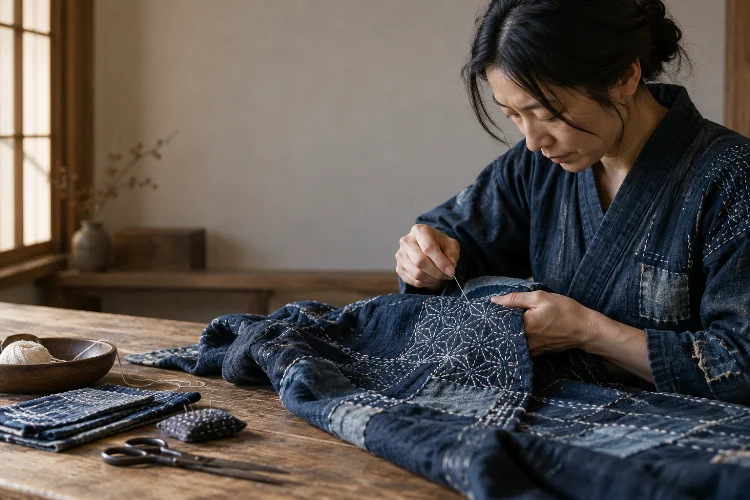
Today, Sashiko often appears on social media as rows of neat white stitches forming beautiful geometric patterns on deep indigo fabric. It can look like a purely decorative form of Japanese embroidery, designed mainly to make clothing or accessories more visually interesting.
Historically, however, decoration was only part of the story.
Japanese Sashiko developed as a practical textile technique that could reinforce fabric, connect layers of cloth, repair worn garments, and make working clothes warmer and more durable.
The Metropolitan Museum of Art describes Sashiko as a quilting technique used to extend the life of textiles or join recycled pieces into new garments. Farmers used the method to create stronger and warmer clothing before its stitching became increasingly decorative.
Understanding Japanese Sashiko beyond its decorative applications therefore reveals a broader history of resourcefulness, labor, household economy, and regional identity.
What looks like a simple running stitch can tell us how ordinary people maintained valuable textiles, adapted clothing to difficult climates, and turned necessity into a distinctive visual tradition.
Sashiko Originally Served a Practical Purpose
The foundation of Sashiko is remarkably simple: repeated running stitches pass through one or more layers of fabric.
Those stitches can strengthen areas exposed to heavy use.
Instead of throwing away a garment when the cloth became thin, a household could add another layer underneath or over the damaged section and stitch the materials together.
The process extended the life of fabric at a time when replacing clothing required far more labor and expense than buying a new shirt does today.
The Met’s nineteenth-century Sashiko jacket shows exactly this relationship between usefulness and decoration. Its indigo-dyed cotton was quilted with white thread, while interlocking circles and wave patterns transformed reinforcement into visual design.
Practical function came first, but craft skill naturally made those stitches more organized.
Straight rows became grids. Grids could become diamonds, circles, waves, floral forms, and other repeating patterns.
This evolution helps explain why modern viewers sometimes mistake Sashiko for embroidery created only for appearance.
Its beauty grew out of function rather than replacing it.
Reinforcement Made Working Clothes Stronger
Traditional working garments had to survive demanding physical conditions.
Farmers repeatedly bent, carried tools, worked against rough plants, and exposed clothing to mud and weather. Fishermen faced cold water, wind, equipment, and long periods outdoors.
Sashiko helped ordinary cloth withstand that abuse.
The Hokkaido Digital Museum describes quilted working garments used by settlers that protected against cold and injuries from vegetation. Thick Sashiko socks were also made by stitching several layers of cotton together, creating particularly durable soles.
Fishermen used similar principles.
In Kushiro, short coats sometimes known as donza were constructed by quilting layers of indigo cotton or hemp with running stitches. They were designed to retain heat during harsh winter fishing conditions.
Some garments required enormous amounts of work. Hokkaido museum information notes that producing one heavily stitched donza could take more than twenty days.
That labor was not wasted ornamentation.
Every line of stitching helped transform relatively ordinary cloth into a more resistant textile structure.
Sashiko and Boro Are Related but Not Identical
Sashiko and boro are frequently presented as if they describe the same thing.
They do not.
Sashiko refers broadly to stitching or quilting techniques based around repeated running stitches. Boro describes textiles that have been repeatedly patched, repaired, layered, and reused, often over very long periods.
The two traditions frequently overlap.
A damaged garment could receive a patch, and Sashiko stitches could then hold that patch securely in place. As additional damage appeared over time, more pieces could be added.
The Victoria and Albert Museum explains that historic boro garments were created by patching worn sections or joining pieces of older clothing, often using running stitches or Sashiko to reinforce layers.
Some nineteenth- and early twentieth-century examples were handed down through multiple generations of rural families.
That distinction matters.
A newly created fabric covered with geometric Sashiko stitching is not automatically boro. Likewise, boro refers to a history of repair and reuse rather than simply a fashionable distressed appearance.
Understanding the difference helps preserve the social context behind both traditions instead of reducing them to modern design styles.
Cold Northern Regions Shaped Sashiko Traditions
Climate played an important role in how Sashiko developed.
Northern Japan experiences cold winters, and historically some communities had limited access to the types of textiles that modern consumers take for granted.
Layering cloth created insulation.
The Metropolitan Museum of Art notes that in northern Japan, where winters were severe and cotton could not easily be cultivated locally, farming and fishing communities joined layers of bast-fiber cloth using valuable cotton thread.
These functional stitches eventually contributed to recognizable decorative Sashiko traditions.
This makes Sashiko a good example of how textile technology responds to geography.
A warmer garment was not merely comfortable. For someone working outdoors during winter, insulation could be essential.
Cotton textiles later became more accessible through trade, but households still had strong reasons to maintain and reuse them.
The physical properties of stitched layers also mattered.
Repeated stitching prevented fabric layers from shifting independently. The resulting structure became thicker and more stable, while damaged sections could be reinforced before they failed completely.
What modern viewers see as a decorative surface was therefore also a form of textile engineering.
Fishermen’s Coats Combined Protection and Identity
Sashiko eventually became more than functional reinforcement in some communities.
Fishermen’s coats from places such as Awaji Island demonstrate how workwear could develop strong social meaning.
The Fowler Museum at UCLA describes sashiko no donza made from layered indigo-dyed cotton. More elaborate coats featured dense patterns in white cotton thread and eventually became symbols connected with the role of fishermen within Awaji society.
Not every garment was equally elaborate.
Simple or heavily worn examples could function as practical boat clothing, while richly decorated coats might be reserved for more visible social situations.
Skilled women produced particularly detailed examples, and ownership could communicate status within the fishing community.
LACMA preserves an early twentieth-century donza combining quilting, patching, Sashiko embroidery, and kasuri-dyed textile sections. Its dense surface contains geometric patterns including concentric squares and hemp-leaf forms.
This is where the distinction between function and decoration becomes less clear.
The stitches strengthened the garment, but they could simultaneously identify craftsmanship, community, occupation, and personal standing.
A practical technology had become cultural expression.
Geometric Patterns Grew From Repeated Stitching
Sashiko is strongly associated today with geometric patterns, and repetition is central to its visual character.
Running stitches lend themselves naturally to lines and grids.
Once those lines intersect or repeat across cloth, relatively simple movements can produce surprisingly complex surfaces.
Historic garments demonstrate considerable variety.
A mid-nineteenth-century Sashiko kimono in The Metropolitan Museum of Art contains seven continuous patterns. Some geometric designs stylize natural forms, including kaki no hana, or persimmon-flower motifs.
Other familiar designs include waves, interlocking circles, hemp-leaf-inspired geometry, and repeating linear structures.
These patterns could help organize stitching evenly across large surfaces, but they also introduced visual identity into everyday cloth.
Importantly, Sashiko should not be treated as one rigid pattern library.
Different communities developed variations based on local habits, textile availability, working conditions, and aesthetic preferences.
The technique is therefore better understood as a family of stitching traditions rather than one universally standardized style.
Its visual complexity emerged through generations of practised repetition.
Indigo and White Became an Iconic Combination
The combination most people associate with Sashiko is white thread against dark indigo fabric.
There were practical reasons behind that appearance.
Indigo-dyed cotton became widely used in Japanese everyday clothing, while pale cotton thread created clear contrast against the dark ground.
The contrast also makes every stitch visible.
Instead of hiding repair work, the stitching can become part of the textile’s appearance.
Historic Sashiko garments in The Met frequently combine indigo-dyed plain-weave cotton with white cotton quilting thread, helping create the aesthetic that remains closely associated with the craft today.
Yet it is important not to assume every historic Sashiko textile looked exactly this way.
Different fibers, fabrics, colors, and regional approaches existed.
The famous blue-and-white combination became an especially recognizable expression of the technique rather than an absolute technical rule.
Modern makers have expanded the palette even further, using Sashiko-inspired stitching on denim, linen, canvas, and textiles of almost any color.
The structure survives even when the traditional color contrast changes.
Repair Connected Sashiko With Household Economy
One of the most important aspects of Sashiko is economic rather than artistic.
Historically, textile production required substantial resources.
Fiber had to be grown, processed, spun, woven, dyed, cut, and sewn. Throwing away cloth because of a small hole made little sense when it could be repaired.
Cooper Hewitt describes mending as a widespread household activity driven largely by economics: repairing clothing was simply cheaper than replacing it.
Japanese common people developed particularly effective repair practices in which boro patchwork and Sashiko stitching could work together.
That context changes how we interpret visible repairs.
Today, an obvious patch may look like an intentional fashion statement.
Historically, it might represent careful household management.
Clothing could accumulate layers of family history as sections were repaired, patched, and reused.
A garment was not necessarily considered finished when it began to wear out. Instead, deterioration started another stage in its material life.
This approach feels remarkably relevant in a modern world concerned about textile waste, even though historical makers were motivated primarily by necessity rather than contemporary environmental theory.
Sashiko Was Also a Form of Domestic Knowledge
Sashiko traditions depended on people knowing how to maintain textiles.
In many communities, women performed much of this work.
Kushiro museum records explain that fishermen’s wives traditionally made and repaired Sashiko coats during winter in preparation for the next fishing season.
That work required more than knowing how to push a needle through fabric.
The maker needed to judge which areas required reinforcement, how many layers were necessary, how tight the stitches should be, and how to distribute stitching without distorting the cloth.
Patterns also had to remain reasonably consistent across large surfaces.
This was technical knowledge learned through observation and practise rather than industrial training.
Such skills could move between generations inside households.
A daughter might learn from a mother or another experienced member of the community, gradually developing the muscle memory required to produce even stitches efficiently.
The finished textile therefore preserves invisible knowledge as much as visible thread.
Modern Visible Mending Gives Sashiko a New Role
Sashiko has gained international attention through the modern visible-mending movement.
Instead of trying to make a repair invisible, makers deliberately emphasize it.
A worn pair of jeans might receive a contrasting patch covered with repeated running stitches. A damaged jacket can become more visually interesting after repair than it was before.
The V&A has used Sashiko in visible-mending workshops, describing the technique as one historically used since Japan’s Edo era to strengthen or repair worn garments.
This contemporary interest creates both opportunities and challenges.
On one hand, it encourages people to repair clothing instead of immediately replacing it. It also introduces wider audiences to hand stitching and Japanese textile traditions.
On the other hand, treating Sashiko only as an Instagram-friendly decoration can strip away its historical background.
Its deeper significance comes from the relationship between necessity, maintenance, skill, and beauty.
The decorative patterns matter, but understanding why people stitched them makes the tradition far richer.
Sashiko Offers a Different Way to Think About Clothing
Modern fashion often treats wear as the end of a garment’s useful life.
Sashiko suggests another possibility.
A weak area can be reinforced. A hole can receive a patch. Multiple worn fabrics can become one stronger textile.
This does not mean historical Japanese households were consciously practicing modern sustainable fashion.
They were responding to economic realities and material scarcity.
Still, the underlying logic feels highly relevant today.
Repair extends product life. Visible stitching can celebrate continued use rather than disguising age. Fabric can accumulate character instead of becoming worthless as soon as it stops looking new.
That idea resembles the Japanese concept often associated with mottainai – regret over unnecessary waste. The V&A connects this principle with historic boro garments passed through generations and repeatedly repaired rather than discarded.
Sashiko therefore gives contemporary makers something more valuable than another decorative technique.
It offers a practical reminder that good design can begin with preserving what already exists.
Understanding Japanese Sashiko beyond its decorative applications reveals a textile tradition shaped by practicality, scarcity, climate, household labor, and community identity.
Running stitches strengthened workwear, joined fabric layers, repaired damage, and helped clothing survive longer.
In fishing and farming communities, those practical stitches gradually developed into sophisticated geometric patterns that could also communicate skill and social identity.
Sashiko’s relationship with boro further shows how repair and reuse formed part of everyday textile life rather than modern sustainability trends.
Today, the technique has found new audiences through fashion and visible mending. If you want to appreciate Sashiko more deeply, look beyond the pattern itself.
Follow the stitches, examine the layers underneath, and consider the original problem the maker was trying to solve. That is where much of Sashiko’s real beauty begins.