
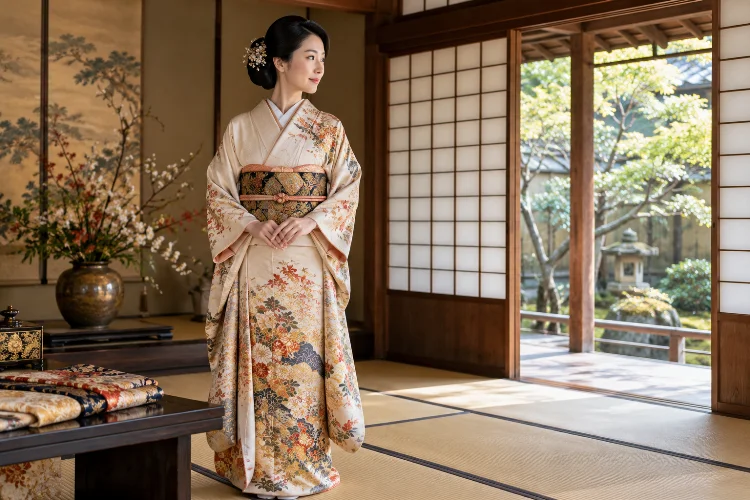
Few garments are as instantly recognizable as the Japanese kimono. Its straight silhouette, wide sleeves, wrapped front, and carefully arranged obi have become visual symbols of Japanese culture around the world.
Yet the kimono did not appear in its modern form overnight.
The historical evolution of traditional Japanese kimono stretches across centuries of political change, textile innovation, social competition, and shifting ideas about beauty.
Its origins can be traced to the kosode, a relatively simple robe that was once worn as an undergarment beneath the elaborate clothing of aristocratic women.
Over time, that modest garment moved outward, becoming increasingly visible and eventually developing into a major fashion statement.
By the Edo period, advances in dyeing, embroidery, resist techniques, and pattern publishing had transformed clothing into a sophisticated visual language. The Meiji era introduced Western dress and changed the kimono’s social position again.
Its story is therefore much larger than fashion. Following the evolution of kimono reveals how Japanese society continuously adapted tradition to changing technology, status, taste, and cultural identity.
The Kimono Grew From the Earlier Kosode
The modern kimono is closely connected with a garment known as the kosode, literally meaning “small sleeves.”
During the Heian period (794–1185), aristocratic women could wear the kosode beneath elaborate multilayered court garments such as the jūnihitoe. Its relatively small sleeve openings distinguished it from the dramatically open sleeves of formal court clothing.
Over time, the kosode stopped being merely an underlayer.
The Kyoto National Museum explains that members of the upper classes gradually began wearing it as an outer garment. Once visible, the simple robe became a surface for increasingly ambitious textile decoration.
Its construction was remarkably efficient.
Rather than shaping fabric closely around the body through complicated tailoring, makers worked with relatively straight pieces of cloth. The resulting T-shaped garment could accommodate different bodies through wrapping, folding, and adjustment.
That basic geometry became one of the most enduring features of Japanese dress.
Instead of constantly redesigning the garment’s basic structure, Japanese textile artists could focus much of their creativity on surface pattern, color, material, and styling.
Medieval Changes Turned an Undergarment Into Outerwear
The transition from undergarment to visible clothing accelerated during Japan’s medieval periods.
As court dress customs changed and warrior elites gained political power, clothing became somewhat less dependent on the multilayered aristocratic systems associated with the Heian court.
The kosode became increasingly important as everyday and formal clothing.
An outer garment known as the uchikake also developed among high-ranking samurai women during the Kamakura period. It was worn over the kosode without being secured by a sash and eventually became important in formal and wedding dress.
This layering system gave clothing new visual possibilities.
The kosode could carry detailed surface decoration while the uchikake created another level of ceremonial display. Colors, fabrics, and motifs could signal status or the importance of an occasion.
The change also reveals something important about fashion history.
Garments rarely develop through a single dramatic invention. Instead, people alter how existing clothing is worn, layered, decorated, and interpreted.
The kimono emerged from exactly that kind of gradual evolution.
Edo Japan Turned Kimono Into a Fashion Industry
The Edo period, from the early seventeenth century to 1868, was one of the most important eras in kimono history.
Japan experienced expanding cities, growing commercial wealth, and a dynamic consumer culture. Samurai families remained important customers for luxury textiles, but prosperous merchants also became influential fashion consumers.
The Metropolitan Museum of Art describes kimono during this period as one of the most visible ways urban residents expressed aesthetic taste. Pattern books and ukiyo-e woodblock prints circulated new clothing ideas much like modern fashion magazines.
Some seventeenth-century kosode became especially bold.
The Kanbun style of the 1660s and 1670s used sweeping, asymmetrical compositions that could extend from a shoulder toward the lower part of a robe. A surviving example in The Met combines tie-dyeing, silk embroidery, and gold-thread couching in large floral roundels.
Clothing was becoming more than something worn.
It had become an artistic surface shaped by fashion cycles, consumer demand, and technical innovation.
Shibori, Embroidery, and Yūzen Expanded Textile Design
The relatively stable shape of the kimono encouraged artisans to concentrate on decorating cloth.
One important technique was shibori, a family of resist-dyeing methods in which sections of cloth are bound, stitched, folded, or otherwise protected before dyeing.
The resulting designs could range from tiny repeated dots to large flowing areas of color.
Embroidery introduced another layer of detail. Silk and metallic threads could highlight flowers, plants, seasonal imagery, or symbolic forms.
Then, during the late seventeenth century, yūzen dyeing dramatically expanded what textile designers could achieve.
Kyoto’s yūzen tradition developed from existing dyeing methods and is associated with the fan designer Miyazaki Yūzensai. Artisans applied resist paste along design outlines so separate colors could be painted with precision without bleeding together.
This made highly pictorial compositions possible.
A kimono could resemble a painting containing trees, flowers, birds, landscapes, and atmospheric shading.
The garment’s construction may have remained deceptively simple, but its surface became technically extraordianry.
Patterns Communicated Seasons, Status, and Meaning
Historic kimono decoration was rarely random.
Flowers, trees, birds, insects, clouds, water, and landscapes could connect the garment with particular seasons or cultural associations.
Plum blossoms, for example, evoke the transition from winter toward spring. Pine can communicate longevity, while cranes are also strongly associated with long life and good fortune.
Wedding garments made symbolism especially visible.
The Met records Edo-period bridal textiles decorated with motifs such as cranes, turtles, pine, bamboo, and plum, all associated with favorable wishes and longevity.
Seasonal awareness could become surprisingly subtle.
One Meiji-period summer kimono depicts insect cages, crickets, grasshoppers, and pampas grass. Although the imagery suggests the approach of autumn, it was associated with the experience of cool summer evenings.
This is one reason understanding kimono requires more than identifying attractive motifs.
The wearer and viewer participated in a shared visual culture.
Choosing the right material, pattern, and season could demonstrate cultural knowledge as clearly as it displayed wealth.
Different Kimono Forms Reflected Social Context
“Kimono” is often used internationally as though it describes one standard garment.
Historically, Japanese dress included numerous related forms.
A furisode is recognized by its long sleeves and became particularly associated with young women. Formal outer robes such as uchikake developed different ceremonial roles, especially in elite and wedding contexts.
Men’s clothing could communicate affiliation in other ways.
An eighteenth- or nineteenth-century men’s kosode in The Met uses a tiny stencil-dyed komon pattern associated with the Nabeshima samurai clan, along with family crests placed at customary positions.
Material and lining also mattered.
Lighter unlined garments could be selected for warm seasons, while heavier or layered robes suited colder weather.
Kimono culture was therefore not just about choosing a beautiful pattern.
Age, gender, family position, ceremony, season, marital status, and degree of formality could all influence what someone wore.
Learning these conventions was part of understanding how clothing worked socially.
Meiji Modernization Changed the Meaning of Kimono
The Meiji Restoration of 1868 brought enormous political and social change.
Japan’s leaders sought rapid modernization while interacting more directly with European and American powers. Western-style clothing became increasingly visible, especially within government and official contexts.
The Met notes that Japanese officials adopted Western dress and that Empress Shōken promoted Western gowns during the late nineteenth century.
Ironically, this helped change how the kimono itself was understood.
As Western clothing became connected with modernization, the kimono became increasingly identifiable as distinctly Japanese national dress.
Traditional forms did not immediately disappear.
Late Edo design habits continued into Meiji clothing. Early Meiji kimono could retain dark grounds and decoration concentrated near the hem, while artisans continued refining yūzen, embroidery, and other textile techniques.
New technologies also changed production.
Stencil yūzen developed in the early Meiji era and helped make richly patterned dyed textiles accessible to broader groups of consumers.
Tradition and modernization were therefore happening at the same time.
Kimono Influenced Western Fashion
As Japan increased contact with the outside world, kimono began attracting international attention.
During the late nineteenth century, Japanese art, prints, ceramics, and textiles became highly fashionable in Europe and North America through the cultural phenomenon generally known as Japonisme.
Western designers studied kimono decoration first.
Floral motifs, asymmetrical compositions, and Japanese visual principles appeared in fashionable European textiles and garments.
Eventually, designers also became interested in construction.
The kimono’s loose shape and geometric cutting offered an alternative to tightly fitted Western tailoring.
The Met notes that designers including Paul Poiret and Madeleine Vionnet drew inspiration from its form, while the V&A describes kimono as a fashion garment that continued evolving both inside and outside Japan.
This exchange did not move in only one direction.
Japanese makers also absorbed outside influences, materials, and fashion ideas.
By the twentieth century, kimono history had become increasingly global.
Modern Kimono Balances Tradition and Reinvention
Kimono today occupies an interesting position.
It is no longer ordinary daily clothing for most Japanese people, but it remains important at weddings, coming-of-age ceremonies, graduations, festivals, tea gatherings, and other formal or cultural occasions.
Traditional craft knowledge also continues.
Yūzen artisans still practice complex resist-dyeing methods in Kyoto, while contemporary textile artists reinterpret historic techniques through modern compositions.
The career of artist Moriguchi Kakō shows how this continuity can work. After training in yūzen, he developed his own techniques and was eventually designated a Living National Treasure.
His 1985 Rakuhoku kimono combined traditional paste-resist dyeing with a distinctly modern artistic composition.
Contemporary makers also experiment beyond silk.
Some Kyoto workshops have adapted hand-painted yūzen methods to denim and modern accessories, showing how heritage techniques can survive by finding new surfaces and audiences.
The result is not simply preservation.
It is continous reinvention.
Kimono remains culturally recognizable because its makers have repeatedly adapted it instead of freezing it at one moment in history.
The historical evolution of traditional Japanese kimono shows how a relatively simple garment can carry centuries of social and artistic change.
Beginning with the kosode, Japanese dress gradually developed through changing court customs, samurai culture, Edo consumer fashion, advanced dyeing techniques, and Meiji modernization.
Shibori, embroidery, yūzen, seasonal imagery, and symbolic motifs transformed the kimono into a sophisticated visual art form. Later, Western clothing altered its everyday role while helping establish it internationally as a symbol of Japan.
Yet kimono has never been completely static.
Contemporary designers and artisans continue adapting its construction and textile techniques for new generations.
To understand Japanese kimono more deeply, look beyond its famous silhouette. Study its fabric, motifs, dyeing, and historical context – because every layer reveals another chapter in Japan’s evolving fashion history.
