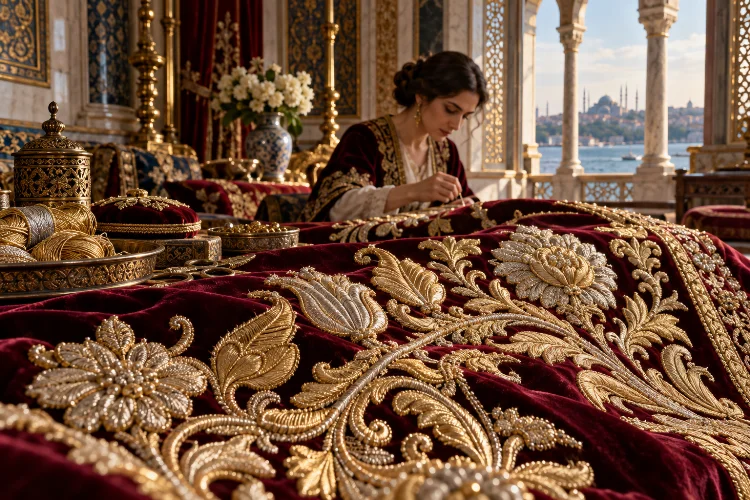
Gold embroidery has a way of making fabric look almost architectural. A line of metallic thread can catch the light like jewelry, while padded areas rise from velvet to create flowers, leaves, inscriptions, and scrolling designs that seem to sit above the cloth rather than inside it.
The historical evolution of Ottoman goldwork embroidery techniques shows how this visual richness developed through centuries of experimentation with metal threads, silk, padding, couching, and highly skilled handwork.
Under the Ottoman Empire, luxurious textiles played important roles in palace culture, ceremonial display, religious furnishings, domestic interiors, and formal clothing. Gold and silver embroidery could communicate status, wealth, devotion, and craftsmanship.
Yet “gold thread” did not always mean a solid strand of gold. Artisans used increasingly sophisticated combinations of gilded silver, metal strips, wrapped cores, silk, and later more affordable materials.
From courtly textiles to nineteenth-century bindallı wedding dresses, Ottoman goldwork constantly adapted. Its history is therefore not simply about luxury – it is also about changing technology, fashion, labor, and the creative ways artisans made metal behave like thread.
Early Ottoman Goldwork Grew From Luxury Textile Traditions
The Ottoman court inherited and developed textile traditions from earlier Islamic, Byzantine, Persian, and Anatolian cultures.
Silk production centers such as Bursa became especially important within the imperial textile economy. Expensive fabrics combined silk with metallic yarns to create surfaces that shimmered in palaces, mosques, ceremonial environments, and elite homes.
Not every metallic textile was embroidered. Ottoman workshops also produced sophisticated woven velvets and brocades containing metal-wrapped threads.
A sixteenth-century Ottoman velvet preserved by The Metropolitan Museum of Art combines fine silk with gilded metal-wrapped thread. Its deep red and gold surface illustrates the luxurious visual environment in which embroidered goldwork also developed.
Embroidery offered a different advantage from weaving.
Instead of building metallic decoration into the entire fabric during loom production, craftspeople could apply precious material selectively to an existing textile. This gave artisans greater flexibility when decorating garments, banners, household textiles, and religious objects.
The technique also helped control cost.
Gold could be concentrated where it produced the strongest visual effect rather than being distributed through every part of the cloth.
Metal-Wrapped Threads Made Goldwork More Practical
One misconception about historic gold embroidery is that artisans simply threaded solid gold wire through fabric.
In reality, precious metallic materials required more careful handling.
Research published by The Metropolitan Museum of Art describes metallic threads made from gilded membrane wrapped around a linen core. Analysis of one historic embroidered textile found a coating containing both silver and gold, with gilded silver providing the luminous outer surface.
This construction had several advantages.
Compared with solid precious metal, wrapped thread could be lighter, more flexible, and less expensive. That made it easier to incorporate into elaborate textile surfaces.
Artisans also tried to protect delicate metalic threads from unnecessary friction.
Repeatedly pulling them through cloth could damage the metal coating. Instead, embroiderers often placed metallic threads directly on the surface and secured them with smaller stitches.
That approach became fundamental to Ottoman goldwork.
It allowed the expensive material to remain visible while ordinary silk or linen stitching did much of the structural work underneath.
Luxury was therefore created through intelligent material engineering as much as through expense.
Couching Became a Core Ottoman Goldwork Technique
Couching is one of the most important techniques for understanding Ottoman metal embroidery.
Instead of passing a thick gold or silver thread repeatedly through the ground fabric, the artisan lays it along the surface. A finer thread then stitches over it at intervals, holding the metallic element securely in place.
This sounds simple, but the technique offers enormous creative possibilities.
Parallel metallic threads can fill large areas. Curved lines can form leaves and arabesques. Closely spaced couching stitches can create subtle textures, while changes in stitch placement can make surfaces appear patterned.
The method also conserves precious material because most of the expensive thread remains on the visible side.
Metropolitan Museum research into historic metallic embroidery shows how couching threads could simultaneously hold metallic yarns, backing materials, and padding together.
Color mattered as well.
Yellow silk could be used to secure gilded threads so that the attachment stitches visually disappeared into the gold. White thread could perform a similar role beneath silver.
The technique demonstrates how Ottoman craftmanship depended on details that might be almost invisible to the viewer.
The glittering surface was carefully engineered from beneath.
Padding Created the Dramatic Raised Effect
Flat gold embroidery could already look luxurious, but Ottoman artisans also developed highly dimensional surfaces.
Padding was the key.
Before applying metallic thread, embroiderers built raised forms using materials such as linen thread, cord, paper, or cardboard. Gold or silver thread was then couched over this foundation.
The result was relief embroidery.
Light struck the raised areas differently from the flat ground, making leaves, flowers, letters, and decorative borders appear almost sculpted.
A nineteenth-century Ottoman sacred textile studied by The Met used layers of linen thread beneath silver and silver-gilt metal wire. The metallic material was then couched over the padding to produce a pronounced raised effect.
This technique was especially effective on important ceremonial objects.
Large Arabic inscriptions could stand out against dark silk, while scrolls, rosettes, and arabesques gained dimensional depth.
The basic principle eventually became extremely important in Ottoman dress embroidery as well.
Rather than seeing goldwork simply as drawing with thread, it is more accurate to think of some forms as low-relief sculpture built on fabric.
Dival Embroidery Refined Raised Ottoman Goldwork
One of the most recognizable later Ottoman goldwork techniques is dival işi, commonly shortened to dival.
The method became particularly associated with elaborate clothing and ceremonial textiles.
In dival work, a design could be built over shaped cardboard or another firm foundation. Gold- or silver-colored metal-wrapped threads were then couched across the raised forms.
The Metropolitan Museum of Art describes nineteenth-century Ottoman bindallı dresses decorated with exactly this technique.
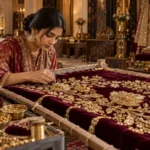
Their large floral forms were embroidered over cardboard with metallic thread, producing thick, glittering designs that stood clearly above velvet backgrounds.
This structural approach created very different results from ordinary flat embroidery.
Leaves could appear full and dimensional. Garlands seemed almost applied to the surface. Large blossoms reflected light from different angles as the wearer moved.
The process required extremely careful planning.
The artisan had to shape the underlying form, keep the metallic threads neatly aligned, and secure the design without crushing the relief.
Dival therefore represents the convergence of embroidery, surface design, and three-dimensional construction.
Bindallı Dresses Turned Goldwork Into Ceremonial Fashion
During the second half of the nineteenth century, goldwork became especially visible in Ottoman women’s ceremonial clothing.
The bindallı is one of the best-known examples.
The name roughly means “a thousand branches,” referring to the dense botanical decoration commonly spread across the garment. These dresses were worn for weddings and other important occasions in Anatolia and the Balkans.
The Metropolitan Museum of Art preserves several examples decorated with large garlands, leaves, and floral sprays executed using metallic dival embroidery.
Velvet was particularly suitable for this work.
Its deep, soft surface provided dramatic contrast against bright gold or silver thread. Rich reds, purples, blues, and dark tones made metallic patterns appear even more luminous.
Matching accessories could extend the design.
Late Ottoman women’s shoes, for example, were sometimes produced from similar velvet and embroidered with raised metallic floral patterns so that garments and footwear worked as coordinated ensembles.
This was ceremonial clothing designed for visual impact.
The underlying motifs still reflected established Ottoman decorative traditions, but changes in garment shape also reveal increasing interaction with European fashion during the nineteenth century.
Goldwork remained traditional while the silhouette around it evolved.
Gold Embroidery Was Not Limited to Clothing
Ottoman metal embroidery appeared far beyond wedding dresses.
Household and bath textiles demonstrate how decorative goldwork entered social life in different settings.
The Metropolitan Museum of Art preserves nineteenth-century Ottoman towels embroidered with silk, metal-wrapped thread, and tinsel. Bathhouses were important social environments, and luxurious personal textiles could quietly communicate family wealth and status.
Goldwork also decorated cushions, covers, ceremonial hangings, and other furnishings.
Within wealthy interiors, textiles were everywhere.
Ottoman seating arrangements relied heavily on cushions and bolsters, making textiles important components of interior architecture rather than minor accessories.
Religious and imperial contexts pushed goldwork toward even greater splendor.
Metallic inscriptions and floral ornament could transform dark silk into highly visible ceremonial surfaces. Gold and silver were especially effective in large interiors because they reflected available light.
The same fundamental techniques therefore operated across very different contexts.
A wedding garment, bath towel, sacred hanging, and palace furnishing might all employ metallic decoration, but each communicated prestige in a different way.
Floral Motifs Became Central to Ottoman Goldwork Design
Ottoman embroidery is immediately recognizable for its strong botanical vocabulary.
Tulips, carnations, roses, leaves, scrolling vines, and branching floral arrangements appeared repeatedly in textiles and decorative arts.
These forms suited goldwork particularly well.
Curved metal threads could outline stems, while padded petals created areas of relief. Repetition allowed elaborate compositions to spread rhythmically across garments and furnishings.
By the nineteenth century, bindallı embroidery often used sweeping garlands and large floral sprays rather than the smaller repeating compositions familiar from some earlier Ottoman textiles.
This change reflects broader shifts in taste.
Ottoman design never existed in isolation. Court workshops and commercial artisans responded to Persian influences, European decorative trends, imported materials, and changing consumer preferences.
Yet floral imagery provided continuity.
Even as garment silhouettes and production methods changed, the garden remained one of Ottoman textile art’s most enduring visual ideas.
Goldwork made that imagined garden shimmer.
Cheaper Techniques Changed Goldwork in the Late Ottoman Period
Luxury craft traditions survive partly because artisans find ways to reduce cost.
By around 1900, some Ottoman garments achieved a goldwork-like appearance without relying on the same labor-intensive embroidery processes used previously.
A cepken jacket in The Metropolitan Museum of Art demonstrates this transition.
The garment is decorated using laid cord and thick gold braid. According to the museum, the effect resembles older garments richly embroidered with gold metal-wrapped thread, but the newer method required less labor.
This is an important stage in the historical evolution of Ottoman goldwork.
It shows that visual prestige could survive even when manufacturing changed.
Consumers still wanted shimmering surfaces and elaborate ornament, but artisans adapted materials and techniques to changing economic conditions.
Industrial production also affected metallic threads themselves.
More affordable metal alloys, manufactured trims, and commercially produced decorative components gradually expanded the range of people who could access the goldwork aesthetic.
The result was not simply the disappearance of traditional craft.
Instead, expensive techniques existed alongside faster substitutes.
That tension between handwork, cost, and imitation is still familiar in modern fashion today.
Ottoman Goldwork Survived Through Bridal and Regional Craft Traditions
The Ottoman Empire ended in the early twentieth century, but its textile techniques did not disappear.
Dival embroidery, metallic couching, and related forms continued within regional Turkish craft traditions.
Museums in Türkiye preserve examples of bindallı and other garments embroidered in gold and silver thread. İzmir’s Ethnography Museum, for example, displays nineteenth-century bridal garments decorated using dival and related metallic embroidery techniques.
These objects show how courtly aesthetics moved into broader ceremonial culture.
Today, Ottoman-inspired gold embroidery can appear in bridal garments, traditional costumes, accessories, decorative panels, restoration projects, and contemporary fashion.
Materials have continued to change.
Modern metallic thread is usually far more affordable than historic silver-gilt wire. Synthetic cores and modern coatings can imitate the appearance of precious metal without the original cost.
Yet traditional hand methods still require patience.
Artisans must control thread direction, padding, spacing, pattern symmetry, and fabric tension.
The craft survives not because every material remains historically identical, but because the underlying knowledge continues to be practised.
Why Ottoman Goldwork Still Matters
Historic Ottoman gold embroidery provides an unusually clear example of how material, technology, and social meaning interact.
Gold communicated luxury, but the techniques developed around it were remarkably practical.
Couching protected delicate metallic surfaces. Padding maximized visual impact. Wrapped threads reduced weight and expense. Later cord techniques reproduced the general effect with less labor.
Every technical change responded to a problem.
That is why these textiles are useful for understanding historical innovation.
They also reveal the huge amount of invisible labor behind luxury.
A finished floral design may appear effortless, but producing it could involve drawing patterns, preparing padding, aligning metallic strands, couching hundreds of sections, and finishing edges by hand.
The visible gold is only the final layer.
Beneath it sits generations of specialised textile knowledge.
The historical evolution of Ottoman goldwork embroidery techniques stretches from sophisticated precious-metal couching to raised padded embroidery, dival work, bindallı wedding garments, and later techniques designed to reproduce luxurious effects more efficiently.
Throughout that evolution, artisans continually balanced beauty with practical concerns. Metal-wrapped threads reduced weight, couching protected fragile surfaces, and padding created dramatic relief without requiring solid masses of precious material.
Goldwork appeared on royal and religious textiles, clothing, bath accessories, furnishings, and ceremonial garments, making it part of both elite display and social tradition.
To appreciate Ottoman embroidery fully, look beyond the glitter. Examine how the metal sits on the surface, where padding creates height, and how individual threads follow each curve.
Those tiny technical choices reveal the remarkable engineering behind centuries of Ottoman textile artistry.