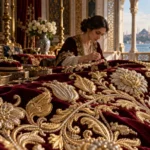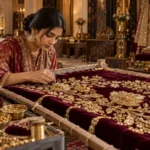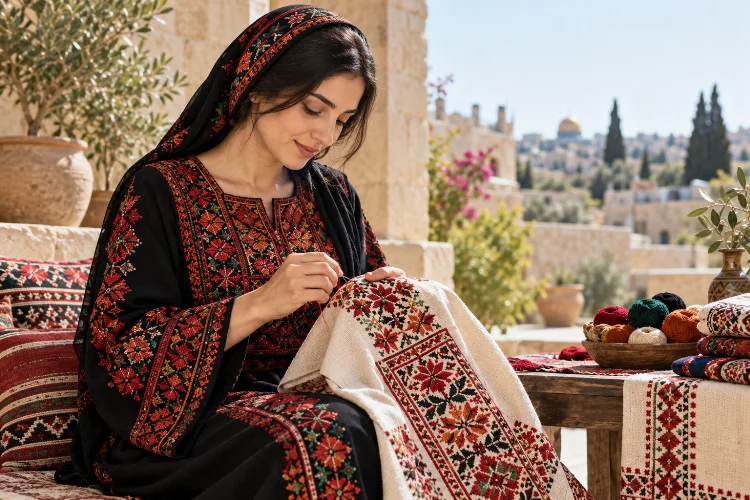
At first glance, Palestinian Tatreez can look like a collection of colorful geometric stitches decorating a dress. Look more closely, however, and those tiny crosses begin to resemble a visual language.
For generations, Palestinian women used embroidery to decorate garments, especially the traditional thobe.
Colors, stitch arrangements, fabric choices, and motifs could reflect where a woman came from, aspects of her social life, and the embroidery traditions practiced within her community.
UNESCO describes Palestinian embroidery as a social and intergenerational practice using geometric designs alongside images of birds, trees, and flowers.
In 2021, “The art of embroidery in Palestine, practices, skills, knowledge and rituals” was inscribed on UNESCO’s Representative List of the Intangible Cultural Heritage of Humanity.
Exploring Palestinian Tatreez and its cultural heritage patterns therefore means looking beyond decoration. Every stitched panel can preserve information about geography, family knowledge, women’s labor, historical change, and cultural identity.
Tatreez Is More Than Decorative Embroidery
The word tatreez is commonly used for elaborate Palestinian hand embroidery. Cross-stitch is especially prominent, although historic garments can include other embroidery techniques, couching, joining stitches, appliqué, and decorative finishing.
Traditional embroidery was closely linked to clothing.
A woman’s thobe could contain heavily embroidered chest panels, sleeves, side sections, cuffs, and lower panels. These areas were carefully planned rather than randomly decorated.
UNESCO notes that Palestinian village clothing traditionally included a long dress accompanied by other garments and accessories.
Embroidery was often worked in silk thread on linen, cotton, or wool, with colors and patterns helping communicate regional identity as well as marital and economic status.
This is what makes tatreez culturally important.
A garment could operate almost like a wearable biography. Its cut, stitches, materials, and ornamentation carried information that people familiar with the tradition could recognize.
The V&A describes Palestinian embroidery as “a language as much as a craft,” emphasizing how clothing reflected both regional origins and changes in the wearer’s life.
Regional Patterns Created a Visual Map of Palestine
One of the most fascinating features of historic tatreez is its regional diversity.
During the late nineteenth and early twentieth centuries, different areas were associated with recognizable garment forms, stitches, colors, and patterns.
According to the V&A, areas such as Ramallah, Bethlehem, and the southern coastal region developed notably distinctive embroidery traditions.
Ramallah, for example, became strongly associated with red embroidery worked on natural or light-colored linen. Surviving V&A garments from the early twentieth century show fine cross-stitch applied to locally recognizable dress forms.
Bethlehem developed another distinctive tradition.
A nineteenth-century Bethlehem Malak thobe preserved by the Palestinian Museum combines silk and gilded threads with tahriri, a couching technique. Its construction and ornamentation look noticeably different from many cross-stitched village dresses.
Bedouin embroidery from the Bir al-Sabi’ area had its own visual character as well. One 1930s–1940s thobe in the Palestinian Museum uses dense geometric embroidery dominated by red silk thread with additional blue, yellow, and green.
Tatreez therefore created something close to a textile geography.
The Thobe Became a Canvas for Cultural Identity
The traditional Palestinian thobe provided a large surface on which embroidery could communicate both personal and regional identity.
Different sections of the garment served different visual purposes.
The chest panel, known as the qabbeh, was often one of the most densely decorated areas. Sleeves, cuffs, side panels, and the lower portion of the dress could contain additional patterns arranged in carefully balanced rows.
A Beit Dajan thobe dating roughly to 1920–1930 shows just how complex this system could become.
The Palestinian Museum records motifs including feathers, roses, the Star of Bethlehem, cypress trees, mountains, grape vines, and geometric forms distributed across different areas of the garment.
This organization meant that embroidery was experienced as part of the complete silhouette rather than as a small isolated ornament.
The dress itself became the framework for the design.
Historic garments also demonstrate that tatreez was never completely standardized. Women could work within regional conventions while introducing variations based on skill, available thread, personal preference, and family knowledge.
That combination of shared tradition and individual choice gave each thobe its own identitiy.
Motifs Drew Inspiration From Nature and Everyday Life
Tatreez patterns often have wonderfully descriptive names.
Cypress trees, roses, feathers, mountains, grape vines, wheat ears, birds, stars, palms, pots, and other recognizable forms appear repeatedly in museum collections.
A Bayt Nabala working thobe preserved by the Palestinian Museum includes motifs locally described as wheat ears, Pasha’s tent, cypress trees, high palms, mountains, fans, and rose patterns.
Another dress from Sarafand combines roses, feather designs, cypress forms, and duck-like animal motifs.
These names show how embroidery drew inspiration from landscapes, plants, animals, architecture, and everyday surroundings.
However, it is useful to be cautious when assigning universal symbolic meanings to every pattern.
The same motif could be interpreted differently across places or generations, and modern explanations sometimes simplify traditions that were much more locally specific.
What we can see clearly is that repeated motifs created a visual vocabulary.
By stitching familiar forms into clothing, women transformed their surrounding environment into geometric textile designs that could be carried from one generation to another.
Tatreez Knowledge Passed Between Generations
Tatreez was traditionally learned through practice.
Girls could begin developing embroidery skills relatively young, observing mothers, relatives, and other experienced women. The process required learning more than individual stitches.
A maker needed to understand thread counting, symmetry, spacing, garment construction, color relationships, and how a pattern expanded across fabric.
The Metropolitan Museum of Art preserves a Palestinian dress dating to the nineteenth or early twentieth century and notes the historic importance placed on embroidery skill among young women.
UNESCO similarly emphasizes that Palestinian embroidery remains an intergenerational and social practice, historically transmitted from mother to daughter and today also taught through formal courses.
That social dimension matters.
Embroidery could bring women together while they worked, exchanged designs, discussed techniques, and taught younger makers.
The finished textile therefore preserves more than a pattern.
It represents hours of shared knowledge.
A diagram can record where stitches belong, but experienced makers also understand thread tension, fabric behavior, counting rhythm, and how to correct mistakes—knowledge that is often easier to learn beside another embroiderer than from a book.
Historical Change Transformed Tatreez Patterns
Textile traditions never exist outside history.
During the twentieth century, Palestinian dress changed significantly as people moved, communities were displaced, new fabrics became available, and regional styles increasingly encountered one another.
The Metropolitan Museum of Art describes how, after 1948, embroidery traditions that had once strongly communicated specific village or regional identities increasingly contributed to a broader Palestinian national visual identity.
Designs circulated among women from different areas, particularly within displaced communties.
This did not mean older traditions simply disappeared.
Instead, motifs were recombined, adapted, and given new contexts.
Changes in materials also influenced the appearance of embroidery.
Handwoven linen could be replaced by commercially manufactured cloth. New threads introduced additional colors, while changing fashion altered garment cuts and pattern placement.
This adaptability is one reason tatreez survived.
A cultural tradition does not necessarily remain alive by reproducing exactly the same object forever. It survives when people continue understanding, using, and transforming its underlying knowledge.
Tatreez Became Important Across the Palestinian Diaspora
Tatreez is no longer limited to the villages where many historic styles originally developed.
UNESCO notes that traditional Palestinian embroidery is now practiced throughout Palestine and among members of the diaspora.
That geographic expansion changed its cultural role.
For someone living far from the place associated with a family’s embroidery tradition, stitching a particular motif can become a way of maintaining a connection with ancestry and cultural memory.
Tatreez now appears on traditional thobes as well as jackets, scarves, bags, cushions, contemporary dresses, artworks, and fashion pieces.
Modern designers may enlarge historic motifs, change their colors, place them on unexpected materials, or combine them with contemporary silhouettes.
The format changes, but the underlying visual vocabulary remains recognizable.
This is especially important for diaspora heritage.
Cultural memory does not have to exist only inside museums. A stitched panel on a modern garment can keep a traditonal technique visible within everyday life.
Preservation Requires More Than Saving Old Dresses
Museums play a major role in protecting Palestinian textile heritage.
The Palestinian Museum maintains historic thobes from areas including Ramallah, Jaffa, Bethlehem, Bir al-Sabi’, and Ramla. Its collections also include separate embroidery samples created specifically to save and preserve tatreez designs.
International museums are also expanding research into the materials behind the craft.
The V&A and British Museum have collaborated on scientific analysis of dyes and fibers used in historic Palestinian dress, helping researchers understand embroidery materials and production methods from the late nineteenth and early twentieth centuries.
Yet objects alone cannot preserve everything.
Tatreez remains living heritage because people still embroider.
Patterns need to be counted, stitched, corrected, taught, and reinterpreted. When younger makers learn the technique from experienced embroiderers, they preserve information that cannot always be reconstructed from an old garment.
Contemporary exhibitions reinforce this connection. Recent V&A projects have placed historic Palestinian garments alongside work by contemporary designers and artists who continue to engage with inherited embroidery traditions.
Preservation therefore involves both archives and active hands.
Exploring Palestinian Tatreez and its cultural heritage patterns reveals far more than decorative needlework.
Historic embroidery recorded regional identities through distinctive colors, stitches, garment forms, and motifs drawn from plants, animals, landscapes, and everyday life.
The traditional thobe became a canvas where personal creativity met shared community knowledge. As Palestinian communities experienced major social changes and movement across borders, tatreez adapted as well, increasingly carrying cultural memory into new places.
Its recognition by UNESCO in 2021 highlights the importance of keeping this living tradition visible.
To understand tatreez more deeply, look closely at historic thobes, learn where particular patterns originated, and support the artisans and cultural institutions preserving the craft today. Every embroidered cross may be tiny, but together they carry generations of history.