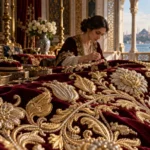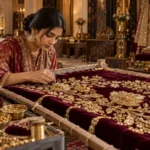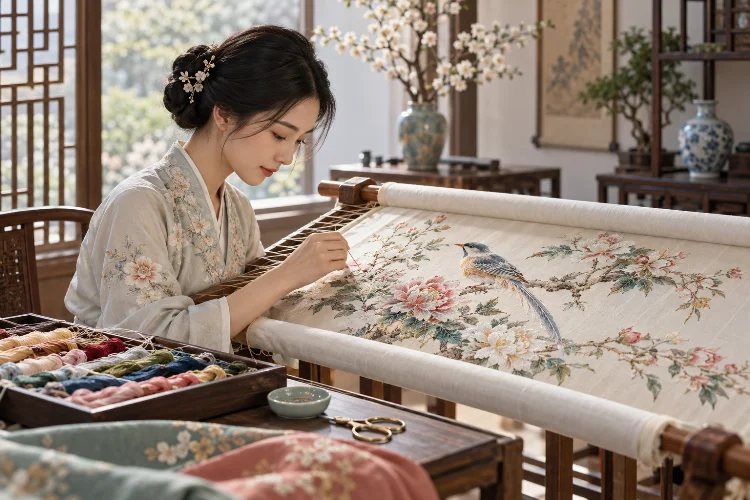
A piece of traditional Chinese embroidery can look almost like a painting until you move closer. What appears to be a bird’s feather, flower petal, mountain, or flowing robe is actually built from hundreds or thousands of carefully positioned stitches.
That technical skill is only one reason these textiles matter.
The cultural heritage of traditional Chinese embroidery reflects centuries of artistic development, regional identity, social customs, religious beliefs, imperial fashion, and international trade.
Silk provided Chinese embroiderers with an especially versatile material because its thin, strong fibers could create smooth outlines, delicate shading, and remarkably detailed images.
The Metropolitan Museum of Art has described historic Chinese silk embroidery as capable of producing painting-like landscapes, flowers, birds, figures, and even calligraphy.
Over time, different regions developed recognizable techniques and visual styles. Su, Xiang, Shu, and Yue embroidery became especially famous.
Exploring these traditions reveals that embroidery was never simply decoration. It could express identity, status, wishes for good fortune, religious devotion, and even relationships between China and the wider world.
Chinese Embroidery Developed Into a Sophisticated Art Form
Embroidery has been practiced in China for thousands of years, closely connected with the country’s long history of silk production.
The basic concept is simple: a needle carries thread through an existing textile surface. Yet Chinese embroiderers transformed that straightforward process into an extraordinary visual language.
Silk was especially suited to detailed needlework.
The Victoria and Albert Museum notes that untwisted silk threads create a rich sheen, while twisted threads can provide stronger and bolder lines.
Different stitch types, thread directions, and padded techniques can also produce changes in texture and three-dimensional appearance.
Skilled artisans learned to control light through thread direction.
Two areas embroidered with exactly the same silk color can look different when their stitches run in different directions because the fibers reflect light differently.
This allows a craftsperson to suggest the curve of a leaf, the softness of animal fur, or subtle changes across a human face.
That combination of technical control and artistic judgement helped embroidery develop into a respected form of textile art rather than simply garment decoration.
The Four Major Regional Styles Created Distinct Identities
Chinese embroidery is often discussed through four famous regional traditions: Su, Xiang, Shu, and Yue embroidery.
The Victoria and Albert Museum identifies each with distinctive visual characteristics. Su embroidery from Jiangsu is particularly associated with naturalistic colors, while Shu embroidery from Sichuan often features subjects drawn from the natural world.
Xiang embroidery from Hunan became known for effects inspired by painting, engraving, and calligraphy, while Yue embroidery from Guangdong is recognized for stronger colors and motifs such as dragons and phoenixes.
These regional differences demonstrate how embroidery can preserve local identity.
1. Su Embroidery
Su embroidery became famous for extremely fine silk threads and smooth, carefully controlled surfaces. Subtle color transitions allow embroiderers to reproduce birds, flowers, animals, and landscapes with impressive realism.
Some techniques even produce double-sided work in which both faces of the textile appear finished.
2. Xiang Embroidery
Xiang embroidery developed a strong relationship with Chinese painting traditions. Craftspeople became skilled at translating brush-like effects into thread, making animals and landscapes appear unusually expressive.
3. Shu and Yue Embroidery
Shu embroidery is strongly associated with Sichuan and often makes extensive use of natural imagery.
Yue embroidery, connected with Guangdong, tends toward bolder decorative impact. Brilliant colors, birds, dragons, phoenixes, and dense ornamentation make many examples instantly dramatic.
The four traditions share a foundation in needlework but show how regional creativity could transform the same basic technology.
Silk Thread Allowed Embroiderers to “Paint” With a Needle
One reason Chinese embroidery reached such a high level of refinement was the exceptional quality of silk.
A fine silk filament can create details that would be difficult to achieve with thicker fibers. When divided, combined, twisted, or laid at different angles, silk thread provides an enormous range of visual effects.
This is why historic Chinese embroideries can resemble paintings.
The Met’s exhibition Painting with Threads highlighted works dating from the twelfth through nineteenth centuries that included landscapes, flowers, birds, immortals, and calligraphic elements.
The museum emphasized that silk’s thinness and strength were essential to these fluid, detailed compositions.
Embroidery could even imitate brushwork.
Instead of mixing paint, artisans placed neighboring threads of slightly different shades together. Directional stitches could suggest movement in water, feathers, clouds, or robes.
This required far more than patience.
The embroiderer needed a strong understanding of color, composition, thread tension, stitch length, and how silk would respond to changing light.
The needle effectively became a brush, while thread became the pigment.
Embroidered Motifs Carried Symbolic Meanings
Traditional Chinese embroidery was rarely decorative without meaning.
Flowers, animals, supernatural beings, household objects, and geometric symbols could communicate wishes or ideas understood by viewers familiar with Chinese visual culture.
Peonies, for example, were often associated with wealth and honor, while peaches could suggest longevity. Bats became particularly interesting symbols because the Chinese word for bat sounds similar to the word associated with good fortune.
A sixteenth-century embroidered panel in The Metropolitan Museum of Art depicts a Daoist magician with tiny bats emerging from a bottle marked with a character associated with happiness. The imagery uses this linguistic relationship to turn decoration into an auspicious message.
Later textile designs could become even more layered.
During the Qing dynasty, the decorative tradition known as the “hundred antiques” incorporated objects associated with scholarship, antiquity, and refined taste. Some combinations worked as visual rebuses expressing auspicious wishes.
Understanding those symbols changes how we view embroidered cloth.
A flower might not simply be attractive. A bird, fruit, mythical creature, or household object could communicate a message about prosperity, longevity, happiness, rank, or spiritual belief.
Embroidery Was Closely Connected With Imperial Culture
Fine embroidery also played an important role in court culture.
Imperial China used textiles to communicate hierarchy, authority, refinement, and political legitimacy. Elaborately embroidered garments and furnishings required expensive silk and highly trained labor, making them natural indicators of status.
Religious works commissioned within the imperial environment could reach extraordinary levels of craftmanship.
A spectacular Qing dynasty embroidery of the eleven-headed bodhisattva Guanyin in The Met’s collection dates to 1778.
The textile includes a thousand arms surrounding the central figure, each with an eye represented in the palm. An inscription records that the work was created under imperial command during the Qianlong reign.
Other embroidered panels depicted immortals and auspicious religious scenes.
An eighteenth-century Qing panel showing the Eight Immortals and the God of Longevity uses silk and metallic thread on satin. The Met describes it as luxurious enough to have served as an impressive birthday gift.
Embroidery therefore operated at the intersection of art, religion, ceremony, and power.
Traditional Embroidery Connected China With Global Trade
Chinese embroidery did not remain inside China’s borders.
Luxury textiles travelled through trade networks, diplomatic exchanges, gifts, and international markets.
During the medieval period, exceptional embroidered and woven silks could be presented by emperors and imperial families to rulers, emissaries, and distinguished individuals.
These textiles were valuable not only because of their materials but because they displayed technological expertise and courtly prestige.
Later, Chinese workshops adapted products specifically for overseas consumers.
Guangzhou became especially important in export textile production during the Qing period. A fascinating embroidered silk palampore now held by The Met demonstrates just how international design could become.
Its central tree motif had roots in Chinese design, was adapted in England, transferred through East India Company trade to Indian textile producers, and later recreated by Cantonese embroiderers in China for Western customers.
That single object represents a remarkable circle of artistic exchange.
Chinese embroidery therefore absorbed outside influences while simultaneously shaping foreign decorative tastes.
It was part of an early global design economy.
Embroidery Preserved Stories, Beliefs, and Everyday Culture
Historic embroidery gives researchers access to far more than textile techniques.
Images stitched into fabric can preserve information about clothing, plants, architecture, religious practices, social roles, and popular beliefs.
Chinese artists frequently adapted themes familiar from painting and literature.
Landscapes, famous immortals, birds and flowers, Daoist figures, Buddhist deities, and auspicious imagery could all appear on textiles. Calligraphy and seals could even be reproduced in thread, further narrowing the boundary between textile and painting.
Some textiles were designed for religious or ceremonial environments. Others appeared on garments, furniture, household decorations, gifts, and export goods.
This wide range of uses makes embroidery an especially valuable record of cultural life.
Unlike monumental architecture, cloth existed close to the human body and inside domestic spaces.
It accompanied people during celebrations, religious practices, diplomatic encounters, family ceremonies, and daily life.
Every surviving piece can therefore contain layers of personal and cultural memory.
Why Traditional Chinese Embroidery Still Matters Today
Preserving embroidery heritage requires more than keeping historic examples in museums.
The most important knowledge exists in the process itself.
A finished embroidered bird cannot fully explain how an artisan divided the silk thread, selected shades, adjusted tension, changed stitch direction, or created tiny transitions between feathers.
Those skills need to be demonstrated and practised.
Traditional embroidery is therefore a form of living cultural knowledge. Techniques survive when experienced makers teach younger craftspeople how to handle materials, interpret designs, and solve the countless small problems that appear during hand production.
Modern artisans do not necessarily need to reproduce historical works exactly.
New subjects, materials, and contemporary designs can coexist with traditional methods.
In fact, adaptation has always been part of Chinese textile history. Regional styles changed, international trade introduced new influences, and artisans responded to changing tastes.
Preservation is strongest when the tradition remains creative rather than becoming frozen in the past.
The cultural heritage of traditional Chinese embroidery combines artistic imagination, technical precision, regional identity, symbolism, religion, and centuries of accumulated craft knowledge.
Su, Xiang, Shu, and Yue embroidery developed distinctive approaches, while skilled artisans used fine silk threads to create images that could rival painting in detail.
Embroidered textiles also carried messages about prosperity, longevity, spirituality, and social position, while luxury pieces travelled through courts and international trade networks.
Most importantly, this heritage continues through people who still understand how to transform thread into imagery.
When you encounter Chinese embroidery, look beyond the surface decoration. Study the direction of the stitches, the choice of motifs, and the subtle changes in color.
Each detail can reveal another layer of China’s textile history – and another reason these remarkable traditions deserve continued attention.