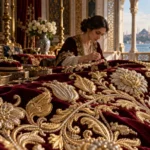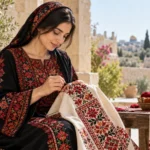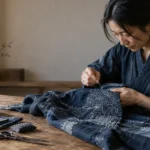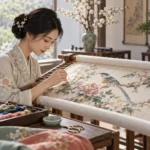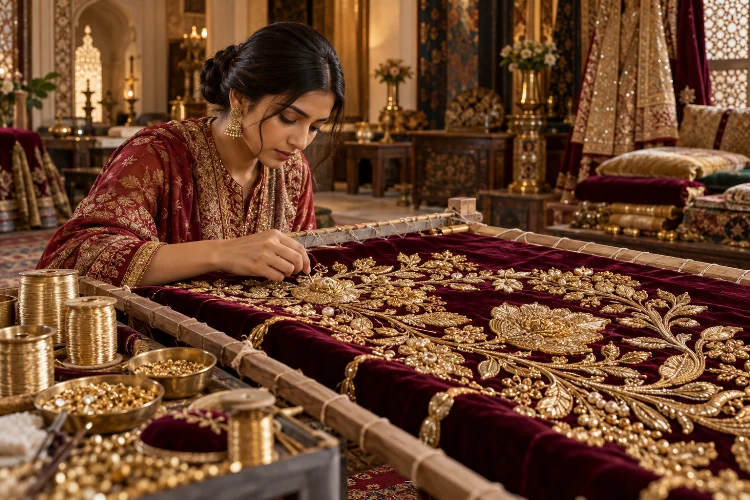
Few embroidery styles communicate luxury as immediately as Zardozi. Gold-colored coils shimmer against velvet, tiny beads catch the light, and raised floral motifs turn an ordinary textile surface into something that looks almost like jewelry.
Indian Zardozi embroidery has long been associated with royal craft traditions. The name comes from Persian roots: zar refers to gold, while dozi relates to sewing or embroidery.
Historically, artisans worked with precious metallic materials to decorate ceremonial clothing, palace furnishings, animal trappings, and other prestigious objects.
Under Mughal patronage, the technique became strongly connected with courtly fashion and elite craftsmanship.
Today, artisans rarely rely on pure gold and silver. Copper, metallic yarn, sequins, beads, and synthetic alternatives have made the technique more accessible.
Yet the basic craft survives. Fabric is still stretched tightly, patterns are carefully transferred, and decorative elements are attached by hand.
That continuity is why Zardozi remains much more than fashionable embellishment – it is a living connection between royal textile culture and contemporary India.
Zardozi Became Closely Linked With Royal Patronage
The visual character of Zardozi makes its connection with royal culture easy to understand.
Metallic threads naturally communicate wealth. When those materials were made from actual gold or silver, embroidered textiles represented considerable financial value before the labor of the artisan was even considered.
The craft flourished under Mughal rule and was used for courtly garments and elite decoration. Traditional applications extended beyond clothing to royal tents, wall hangings, and elaborate coverings for horses and elephants.
Its association with prestige continued in later centuries. The Victoria and Albert Museum notes that Zardozi became a favored embroidery for palace furnishings and animal trappings in India during the eighteenth and nineteenth centuries.
That history shaped the visual language of the craft.
Dense decoration, shimmering surfaces, luxurious fabrics, and elaborate floral patterns all communicated status. Zardozi was not supposed to disappear quietly into the background. Its purpose was partly to be noticed.
In royal settings, embroidered cloth functioned almost like wearable wealth.
The Adda Turns Fabric Into an Artisan’s Workbench
The process begins by creating a stable surface.
Zardozi artisans traditionally stretch fabric across a wooden frame commonly called an adda or karchob. The frame keeps the material taut so the craftsperson can attach decorative elements precisely without allowing the textile to wrinkle or shift.
Official information from India’s Development Commissioner for Handicrafts describes this system in both Lucknow and Banaras Zardozi production. Designs are transferred to the fabric before it is stretched tightly over the frame for embroidery.
The technique is often collaborative.
A large piece can provide enough working space for several artisans sitting around the same frame. Each person may concentrate on a section of the design while following an established pattern.
This arrangement reflects an important feature of traditional craft production.
The finished garment might eventually appear in a luxury boutique, wedding ceremony, or fashion collection, but its creation begins with patient manual work performed close to the textile surface.
The adda may look mechanically simple, yet proper fabric tension is essential. If the cloth moves too freely, detailed metalwork becomes much harder to control.
Metallic Threads Give Zardozi Its Signature Texture
Zardozi is immediately recognizable because its ornamentation sits visibly above the surface.
Traditional materials included gold and silver wire. Modern artisans use a much wider collection of materials such as zari, badla, salma, dabka, kasab, sequins, beads, and metallic coils.
These components create different effects.
Dabka, for example, is a fine coiled wire that can be cut into small segments. Salma provides another coiled metallic texture, while flat metallic strips and wrapped threads create smoother lines.
The Victoria and Albert Museum describes tilla work as a variety of Zardozi in which gold- or silver-wrapped thread can be twisted into small spirals and secured through couching.
Instead of repeatedly pulling delicate metal through cloth, an artisan may position the decorative element on the surface and secure it with finer thread.
This creates a rich dimensional quality.
Light hits each coil, bead, sequin, or metalic strand differently, which gives Zardozi its characteristic sparkle and depth.
The surface becomes almost sculptural rather than simply embroidered.
Mughal-Inspired Motifs Preserve a Historic Visual Language
Technique is only one part of the tradition.
The motifs themselves preserve historical influences.
Government documentation of Indian Zardozi identifies floral forms, leaves, vines, paan or betel-leaf shapes, birds, and geometric patterns among the recurring designs.
Banaras Zardozi also incorporates paisleys, peacocks, lotus motifs, and decorative arrangements influenced by Persian and Mughal aesthetics.
These patterns are not reproduced identically forever.
Artisans reinterpret them according to changing garments, customers, and regional preferences. A floral vine suitable for a nineteenth-century furnishing might later inspire a border on a contemporary lehenga.
That adaptability has helped preserve the craft.
Living traditions rarely survive by refusing to change. Instead, they maintain recognizable techniques and visual ideas while allowing designers and makers to respond to new markets.
Zardozi offers a good example.
A modern wedding garment can look completely contemporary in silhouette while carrying embroidery whose visual vocabulary developed through centuries of royal craft culture.
The past remains visible without turning the garment into a museum reproduction.
Zardozi Requires Skill Beyond Decorative Stitching
Watching an experienced artisan work can make the process look deceptively easy.
In reality, the craft involves careful control over tension, spacing, stitch placement, material weight, and pattern balance.
An artisan must understand how different decorative materials behave. A thin metallic coil does not respond like silk thread, while a bead creates different stress on fabric than a lightweight sequin.
The base cloth matters too.
Historically, luxurious textiles such as silk, velvet, and satin suited the richness of the embroidery. Modern Zardozi can also appear on georgette, chiffon, cotton, and other materials, requiring changes in technique and weight.
Heavy ornamentation on fragile cloth must be planned carefully or the fabric can distort.
This is where craftmenship becomes obvious.
The artisan is not merely filling a traced drawing. They are constantly judging how tightly to secure materials, how much weight the textile can carry, and how decorative elements will interact when the garment bends or moves.
The best work balances visual richness with structural control.
Changing Materials Helped the Craft Survive
Pure precious-metal embroidery would be prohibitively expensive for most modern buyers.
Zardozi survived partly because its materials changed.
India’s handicrafts authorities note that contemporary production frequently substitutes copper, lurex, polyester, and other alternatives for traditional gold and silver. Electroplating and modern finishes can also create metallic surfaces while reducing cost and tarnishing problems.
This transformation might sound like a decline in authenticity, but the reality is more complicated.
Affordable materials opened the craft to a much larger market.
Zardozi can now appear on bridal lehengas, saris, sherwanis, dupattas, handbags, shoes, belts, cushions, and decorative pieces rather than being restricted to royalty or extremely wealthy patrons.
The important technical knowledge can still survive even when the metal changes.
Artisans continue to use framing, tracing, couching, hooked-needle work, coiled elements, and traditional motif construction.
Material adaptation therefore became a practical preservation strategy.
Without it, Zardozi might have remained historically impressive but economically difficult to practise.
Bridal Fashion Keeps Royal Aesthetics Relevant
Modern Indian weddings provide one of Zardozi’s most visible connections with its royal past.
Bridal clothing often values exactly the qualities that define the craft: richness, luminosity, detailed surface decoration, and ceremonial impact.
Gold-toned Zardozi can transform deep red, maroon, green, ivory, or jewel-colored textiles into elaborate wedding garments. Designers can combine metallic thread with sequins, stones, pearls, and beads to create highly dimensional surfaces.
Government craft documentation lists lehengas, saris, suits, dupattas, sherwanis, and other ceremonial garments among contemporary applications.
There is an interesting cultural continuity here.
Historically, Zardozi communicated royal prestige. Today, it often brings that same sense of grandeur to milestone celebrations.
The wearer does not need to belong to an imperial court for the textile to reference courtly aesthetics.
This is one reason traditional techniques remain relevant even as clothing styles evolve.
The craft carries emotional associations with celebration, status, heritage, and special occasions that mass-produced decoration does not always reproduce.
Regional Craft Centers Keep the Tradition Diverse
Zardozi should not be viewed as one completely standardized Indian technique.
Different production centers have developed distinctive reputations and variations.
Lucknow remains strongly associated with fine Zardozi and is officially recognized as a major craft cluster. Government documentation notes that Lucknow Zardozi has received Geographical Indication registration.
Banaras also has an established Zardozi tradition and is listed by India’s handicrafts authorities as a GI textile craft.
Other important centers and traditions appear in places such as Bareilly, Bhopal, Gwalior, Indore, Rajasthan, Gujarat, and Delhi.
Regional production encourages variation in motifs, materials, products, and stylistic preferences.
This diversity matters because craft heritage is strongest when it belongs to practicing communities rather than existing only as a single historical formula.
Every workshop can carry slightly different methods.
Those differences give the tradition room to evolve while preserving its recognizable foundation.
Contemporary Fashion Gives Zardozi a New Audience
Royal patronage once provided demand for highly skilled embroidery.
Today, fashion performs some of that role.
Indian designers regularly incorporate metallic hand embroidery into couture, bridal wear, formal menswear, accessories, and international collections.
The scale may change dramatically.
A traditional motif can become a small detail on a jacket rather than covering an entire ceremonial robe. Metallic embellishment may be combined with minimalist fabrics or contemporary silhouettes.
That flexibility helps prevent the craft from becoming visually trapped in the past.
At the same time, growing demand introduces challenges.
Faster production and lower prices can encourage machine-made substitutes or simplified handwork. Maintaining quality requires customers and designers to understand the difference between genuine labor-intensive embroidery and cheaper imitation.
Preservation therefore depends partly on valuing the artisan’s time.
Royal craft traditions survive most meaningfully when the skills – not just the appearance – remain economically worthwhile for the people who practise them.
Zardozi Preserves Knowledge Through Human Hands
A historic Zardozi garment in a museum can preserve the finished object, but it cannot automatically preserve the skill required to make another one.
That knowledge lives with artisans.
Learning the craft involves understanding how to transfer designs, stretch fabric correctly, handle an ari or needle, cut metallic coils, secure decorative materials, and maintain consistent density.
Much of this is learned through observation and repetition rather than written instructions.
An experienced maker can recognize too much tension simply by feeling the fabric. They know when a motif needs additional reinforcement and when too many embellishments would make a garment uncomfortable.
This type of practical knowledge is easy to underestimate because it is rarely visible in the finished textile.
Yet it is exactly what makes Zardozi a living heritage tradition rather than simply a decorative style.
Preserving the craft ultimately means preserving opportunities for artisans to teach, work, experiment, and earn from their expertise.
Indian Zardozi embroidery preserves royal craft traditions by carrying centuries of textile knowledge into modern clothing and design.
Its metallic threads, raised surfaces, floral motifs, and luxurious materials still echo the courtly environments where the technique once flourished.
The craft has survived because it adapted. Pure gold and silver gave way to more affordable materials, while palace decoration expanded into bridal wear, accessories, fashion, and contemporary interiors.
Yet the essential process remains intensely human.
Every carefully positioned coil and embroidered motif reflects skills developed through practise and passed between generations.
The next time you see a Zardozi garment, look beyond its sparkle. Examine the raised metalwork and tiny stitches closely. Behind that decorative surface is a continuing story of royal patronage, regional identity, artisan knowledge, and Indian textile heritage.