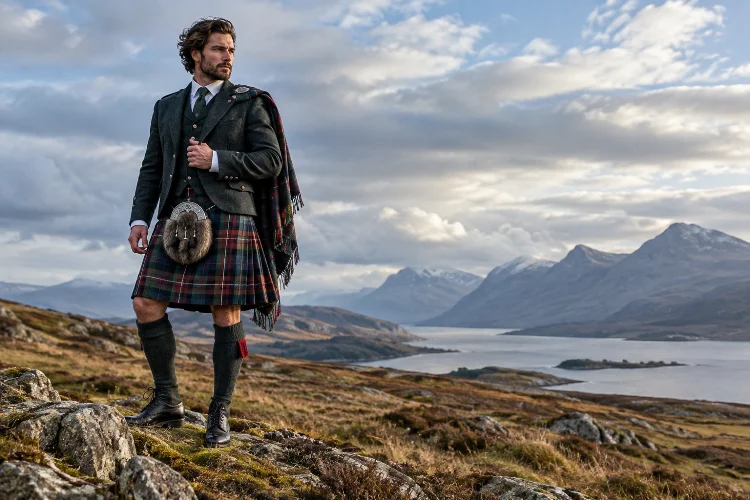
Few forms of traditional clothing are as instantly recognizable as Scottish Highland dress. A tartan kilt, sporran, jacket, long socks, and carefully chosen accessories can communicate “Scotland” before a single word is spoken.
Yet this familiar outfit is not a perfectly preserved costume from the distant medieval past.
Scottish Highland dress evolved through centuries of social and political change. Early Gaelic clothing looked very different from the modern tailored kilt.
The large belted plaid became important during the early modern period, while Jacobite politics turned Highland clothing into a powerful symbol of allegiance.
Government restrictions after the 1745 rising changed how the clothing could be worn, while military regiments helped preserve and reshape it.
During the nineteenth century, Romanticism, royal enthusiasm, commercial weaving, and a growing interest in clan identity transformed Highland dress again.
National Museums Scotland describes the tradition as one repeatedly reinvented to suit changing political, cultural, and social environments.
Its history is therefore less about an unchanging costume and more about continuous cultural adaptation.
The Great Plaid Defined Early Highland Dress
Before the modern kilt, Highland men were strongly associated with the belted plaid, or feileadh mòr.
This garment consisted of a large piece of woolen cloth, often around four to six yards long. The wearer gathered part of the fabric into folds, secured it with a belt around the waist, and arranged the remaining material above the body in different ways.
The lower section created something resembling a loose kilt, while the upper portion could be wrapped around the torso, thrown over a shoulder, or pulled up for additional protection.
That versatility made sense in the Highland enviroment.
One garment could provide clothing, protection against rain and wind, and extra warmth during travel or outdoor activity. Historic descriptions place this belted form firmly in Highland dress by the seventeenth century, with earlier references appearing around the end of the sixteenth century.
Importantly, tartan was common but was not yet necessarily a fixed badge identifying one specific clan.
Different patterns existed, but the modern idea that every Scottish family had one ancient official tartan would develop much later.
The Little Kilt Emerged Through Practical Change
Eventually, Highland dress became less dependent on the enormous upper section of the belted plaid.
A shorter garment known as the feileadh beag, or little kilt, emerged during the eighteenth century. It essentially concentrated the gathered lower portion around the waist without the long upper plaid attached.
There is a famous story claiming that English industrialist Thomas Rawlinson “invented” the short kilt for workers because the great plaid was inconvenient around industrial machinery.
The reality is more complicated.
Historical dress researchers have pointed to evidence suggesting shorter Highland garments already existed before Rawlinson’s supposed invention. It is safer to understand the little kilt as part of a gradual evolution rather than the creation of one individual.
The important change was practical.
A shorter kilt allowed freer movement while keeping the familiar pleated wool around the waist.
Later tailoring transformed it further. Rather than gathering loose fabric every time the garment was worn, pleats could be permanently sewn into place.
That innovation moved Highland dress much closer to the structured kilt familiar today.
Jacobite Politics Turned Clothing Into a Political Symbol
Highland dress became deeply political during the Jacobite era.
Supporters of the exiled Stuart monarchy used tartan and Highland clothing as visible signs of identity and political loyalty. Charles Edward Stuart – better known as Bonnie Prince Charlie – was deliberately represented wearing Highland dress during the 1745 rising.
After the Jacobite defeat at Culloden in 1746, the British government introduced measures intended to weaken the military and cultural structures of the Highlands.
The legislation that came into force in 1747 restricted civilian men and boys from wearing Highland clothing, including the plaid, little kilt, trews, and related garments. Women were not covered by the restriction, and soldiers serving in government forces were exempt.
This distinction is important.
It is sometimes casually said that “tartan was completely banned,” but the historical reality was more specific.
The legislation targeted male civilian Highland dress as part of a broader attempt to control a region associated with rebellion.
The restrictions were eventually repealed in 1782.
By then, however, the meaning of Highland clothing had already begun to change.
The Military Helped Preserve and Reshape Highland Dress
One of the great ironies of the post-Culloden period is that Highland clothing survived partly through the British military.
Highland regiments were allowed to continue wearing distinctive dress even while civilian men faced restrictions.
Military uniforms transformed tartan into something connected not simply with regional Highland culture, but with disciplined service, imperial expansion, and martial reputation.
National Museums Scotland notes that by the later eighteenth century tartan was strongly associated with Scottish participation in the British military.
Regimental dress also encouraged standardization.
Uniforms needed consistent fabrics, recognizable colors, jackets, bonnets, accessories, and practical forms of the kilt. Certain tartan patterns became closely connected with military units, including the dark Government or Black Watch tartan.
Highland regiments then travelled far beyond Scotland.
Through soldiers, military ceremonies, paintings, and parades, the tartan kilt became internationally visible.
A regional style of clothing was gradually becoming one of the world’s most recognizable symbols of Scotland.
The Romantic Era Reinvented the Highland Image
By the early nineteenth century, something surprising happened.
Clothing that had recently been treated with political suspicion became fashionable.
Romantic writers and artists became fascinated by the Highlands as a landscape of mountains, heroic warriors, ancient clans, and dramatic history. Sir Walter Scott played an especially important role in popularizing this imagery.
The visit of King George IV to Edinburgh in 1822 was a turning point.
Highland dress became central to the public spectacle surrounding the visit, helping transform tartan into a broader symbol of Scottish identitiy rather than something belonging exclusively to Highland communities.
Tailoring also became more sophisticated.
National Museums Scotland describes how Georgian-era tailors transformed the loose volume of earlier plaids into structured kilts and coordinated outfits.
Improvements in measuring and tailoring produced more formulaic styles, while heraldic buttons, badges, military-inspired trim, and tartan accessories became increasingly important.
Highland dress was becoming ceremonial fashion.
It still referenced older Gaelic culture, but its appearance was increasingly shaped by nineteenth-century ideas about how that past should look.
Clan Tartans Became More Systematic in the 19th Century
Today, tartan is often strongly associated with family names.
A Campbell wears one pattern, a MacDonald another, and so on.
But that tidy system should not simply be projected backward hundreds of years.
Earlier Highlanders certainly wore tartan, and some patterns could be associated with regions, military units, families, estates, or particular producers. However, the highly commercialized system of formal clan tartans expanded especially during the nineteenth century.
National Museums Scotland notes that clan tartans and clan accessories have been heavily marketed since the mid-nineteenth century.
Romantic publications also helped reinforce the idea that specific patterns represented ancient clan identities.
Industrial textile production made that system easier to maintain. Mills could record patterns, reproduce exact setts, give them recognizable names, and supply customers far beyond the Highlands.
A flexible woven tradition was becoming a catalogued heritage industry.
This did not make clan tartans culturally meaningless.
Quite the opposite: once families and communties adopted them, the patterns gained new social value through weddings, military service, gatherings, Highland games, and family memory.
Traditions can become meaningful even when their standardized form is newer than people assume.
Queen Victoria Helped Make Tartan Fashionable
Royal interest gave Highland style another major boost during the Victorian period.
Queen Victoria and Prince Albert developed a strong attachment to Scotland, particularly through Balmoral.
The royal fascination with Highland landscapes, tartan furnishings, dress, and clan imagery helped turn Scottish style into fashionable material culture well beyond the Highlands.
National Museums Scotland traces this shift from early nineteenth-century Romanticism through Victoria’s celebrated Highland image at Balmoral.
Tartan increasingly appeared not only in men’s Highland outfits but in women’s dresses, interiors, accessories, and fashionable textiles.
Textile producers benefited enormously.
Handloom and industrial weavers could supply an expanding market hungry for Scottish patterns, while books and illustrations helped spread romanticized images of clan dress.
By the late nineteenth century, Highland dress was no longer merely regional clothing.
It had become national symbolism, royal fashion, military uniform, tourist imagery, and international design all at once.
Accessories Completed the Modern Highland Silhouette
The modern Highland outfit involves far more than the kilt.
A formal ensemble may include a tailored jacket, waistcoat, sporran, kilt hose, flashes, brogues, belt, tie or bow tie, and sometimes a sgian-dubh worn with the sock.
These accessories developed different associations over time.
The sporran became especially useful because the traditional kilt has no ordinary trouser pockets. Military and ceremonial influences meanwhile shaped jacket designs, metal fittings, buttons, badges, and other details.
The exact outfit also depends on occasion.
A wedding ensemble may differ from Highland dance clothing, military uniform, casual day wear, or formal evening dress.
This shows how Highland clothing still functions as a flexible system rather than one costume with one correct configuration.
Contemporary wearers choose tartans and accessories according to family connections, aesthetic preference, organizational identity, or simply the event.
The modern silhouette may look “traditional,” but it represents layers of design decisions accumulated over several centuries.
Highland Dress Remains a Living Tradition
Today, Highland dress remains strongly associated with weddings, graduations, ceilidhs, Highland games, formal dinners, pipe bands, military events, and national celebrations.
National Museums Scotland notes that formal kilt suits are commonly bought or hired for important life events. Clan tartans and crest accessories remain central to the commercial Highland wear industry.
At the same time, designers continue experimenting with the form.
New tartans can commemorate places, organizations, events, personal identities, and contemporary causes. Kilts may appear in traditional wool or be reinterpreted through modern fabrics and fashion styling.
Traditional handsewn kiltmaking itself requires specialised skill, and efforts are underway to keep that knowledge alive as experienced makers pass techniques to younger craftspeople.
This combination of continuity and reinvention is important.
Highland dress survived not because it stayed exactly the same, but because each generation found another reason to wear it.
Scottish Highland dress evolved through historical change rather than remaining frozen in one ancient form.
The great belted plaid gave way to shorter and increasingly tailored kilts, while Jacobite politics turned Highland clothing into a symbol powerful enough to attract government restriction.
Military regiments preserved and standardized parts of the tradition. Romanticism, George IV’s 1822 visit, Victorian royal enthusiasm, textile manufacturing, and the growth of clan tartans then transformed Highland dress into a wider symbol of Scotland.
Modern formal kilt wear is the result of all those layers.
When you see Highland dress today, look beyond the tartan pattern. The pleats, accessories, tailoring, and even the idea of clan identification reveal centuries of political conflict, cultural reinvention, fashion, and craft. That complex history is exactly what keeps the tradition alive.