Few garments capture the balance between elegance, tradition, and everyday practicality quite like the kebaya.
Its basic structure seems simple: a fitted or semi-fitted front-opening blouse, often worn with a long cloth, sarong, or batik. Yet behind that familiar silhouette lies a remarkably diverse cultural history.
Understanding the cultural heritage of Indonesian kebaya fashion means looking beyond one “national” style. Kebaya traditions developed differently across Java, Bali, Betawi communities, Peranakan communities, and other parts of the archipelago.
Fabric, embroidery, lace, length, fasteners, and the textile worn below could all change according to region, period, social setting, and personal taste. The garment is also part of a wider Southeast Asian tradition.
In 2024, UNESCO inscribed “Kebaya: knowledge, skills, traditions and practices” on the Representative List of the Intangible Cultural Heritage of Humanity through a multinational nomination involving Indonesia, Brunei Darussalam, Malaysia, Singapore, and Thailand.
That recognition highlights what kebaya has always represented: clothing, craft knowledge, cultural exchange, and living identity at the same time.
Kebaya Is Part of a Shared Southeast Asian Heritage
Trying to identify one single birthplace or one “original” version of kebaya can oversimplify its history.
The garment developed within centuries of cultural movement across maritime Southeast Asia. Trade, migration, court culture, colonial encounters, religion, and local textile traditions all influenced how women dressed.
UNESCO describes kebaya as a front-opening top that can vary in length and may be decorated with intricate embroidery. It is commonly worn with a sarong and can appear at casual gatherings, festivals, formal events, and in performance traditions.
That flexibility helps explain its survival.
Rather than remaining unchanged, kebaya continuously adapted to different communities. Indonesian forms became especially diverse because the archipelago already contained strong local traditions of batik, woven cloth, embroidery, jewelry, and ceremonial dress.
The result is less like one rigid costume and more like a family of related garments.
Two women may both be wearing kebaya while looking very different because fabric choice, cut, lower textile, accessories, and styling communicate different regional identities.
Javanese Kebaya Developed Several Recognizable Forms
Java became one of the most influential centers of kebaya culture.
Two styles frequently discussed today are the kebaya Kartini and kebaya kutubaru.
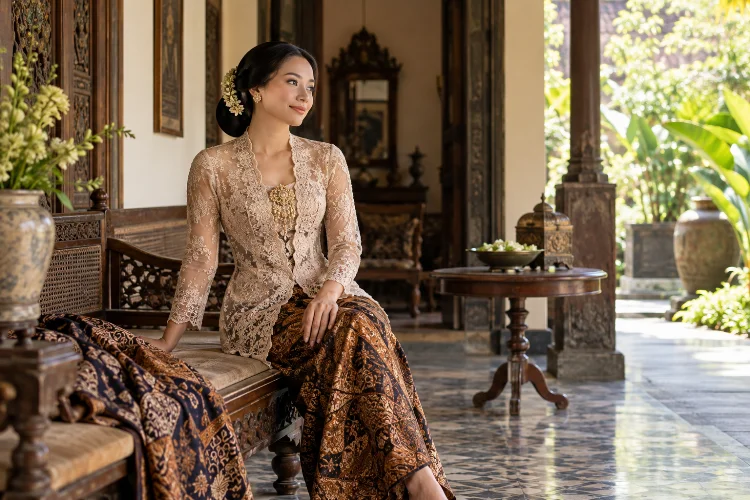
The Kartini-style kebaya typically has a front that meets more directly, while kutubaru includes an additional rectangular panel connecting the two front sides across the chest. Indonesian academic sources describe these as distinct models alongside kebaya encim.
The name “Kartini” reflects the garment’s strong modern association with Raden Ajeng Kartini, whose image became closely tied to Indonesian women’s education, national memory, and traditional dress.
Kutubaru, meanwhile, became particularly recognizable in Central Javanese dress.
These garments were often paired with kain panjang or batik wrapped around the lower body. Museum collections in Jakarta preserve long batik cloths specifically documented as textiles intended to be combined with traditional kebaya.
This pairing is important.
The kebaya itself creates only half the visual identity. Batik motifs, regional color preferences, wrapping methods, and accessories complete the outfit.
In many cases, understanding kebaya means understanding Indonesian textile culture as a whole.
Betawi and Peranakan Styles Reveal Cultural Exchange
Jakarta’s long history as a trading port created another distinctive kebaya tradition.
Betawi clothing developed through interaction among Indigenous communities and people with Chinese, Arab, Malay, European, and other cultural backgrounds.
One example is kebaya kerancang, recognized as Indonesian intangible cultural heritage from Jakarta.
Government heritage documentation describes its characteristic openwork embroidery and notes that the craft reflects cultural influences brought by communities that settled around the old Sunda Kelapa trading environment.
Peranakan communities also contributed strongly to kebaya fashion.
Kebaya encim became famous for lightweight fabrics, colorful embroidery, and decorative edges. Floral and animal motifs could give these garments an especially lively appearance.
Historic examples show how imported and industrial materials entered the tradition as well.
A 1930–1940 ensemble documented by Singapore’s National Heritage Board includes kebaya made from cotton batiste, voile, machine-made lace, and machine embroidery, paired with Indonesian batik sarongs and kain panjang.
This is a good reminder that heritage clothing was never isolated from technology.
Machine lace, commercial fabric, hand-drawn batik, embroidery, and local styling could all exist within the same outfit.
Kebaya and Batik Create a Powerful Textile Partnership
A kebaya rarely tells its full cultural story by itself.
The lower textile is often equally important.
Across Java and other regions, kebaya has traditionally been combined with batik kain panjang, sarongs, or other woven textiles. Museum collections preserve examples from Surakarta, Cirebon, Indramayu, and elsewhere specifically associated with kebaya dress.
The combination creates layers of meaning.
A plain blouse can become visually sophisticated when paired with highly patterned batik. Conversely, an embroidered or lace kebaya may be balanced with a more restrained cloth.
Motifs can also carry regional associations.
Surakarta and Yogyakarta developed famous court batik traditions, while coastal regions such as Cirebon and Pekalongan absorbed especially diverse visual influences through trade.
This means dressing in kebaya can involve careful coordination rather than simply selecting a blouse.
Color, batik pattern, jewelry, hairstyle, sash, footwear, and ceremony all contribute to the final appearance.
The wearer becomes part of the design process.
Bali Gave Kebaya a Distinct Local Character
Kebaya also became deeply integrated into Balinese dress.
Balinese women commonly combine kebaya with wrapped textiles and a sash around the waist. The overall appearance differs from many Javanese forms because styling is shaped by Balinese ceremonial culture and local textiles.
Bali also has its own strong weaving traditions.
Endek, for example, is a Balinese woven textile worn by both men and women with traditional clothing. Museum documentation identifies floral examples used as part of customary dress.
Modern Balinese kebaya can range from simple garments worn for temple-related activities to elaborate lace or embroidered designs used for ceremonies and celebrations.
This variety shows how local communities absorb a shared garment into their own cultural system.
The blouse may belong to the broad kebaya family, but the complete outfit becomes unmistakably Balinese through fabric, sash placement, styling, and ceremonial context.
That relationship between shared form and local interpretation is one of the most interesting aspects of Indonesian kebaya heritage.
Kebaya Carries Social and Ceremonial Meaning
Historically, kebaya could be ordinary clothing as well as formal dress.
Its meaning depended on material and context.
A simple cotton version suited daily activities, while silk, velvet, lace, brocade, elaborate embroidery, or carefully selected batik could turn the garment into ceremonial clothing.
UNESCO emphasizes that kebaya continues to be worn for both casual and formal occasions, including festivals, performances, social events, beauty pageants, and award ceremonies.
In Indonesia, kebaya remains strongly visible at weddings, graduations, national commemorations, cultural ceremonies, official functions, and family celebrations.
This ability to move between private and public life helped preserve its relevance.
Kebaya also became closely associated with ideas of Indonesian womanhood during the twentieth century, although those ideas have never been completely uniform.
Different generations reinterpret it differently.
For some people it represents family memory. For others it expresses national identity, regional pride, fashion, or formal elegance.
Its cultural meaning is therefore constantly being negotiated rather than permanently fixed.
Making Kebaya Preserves Specialized Craft Knowledge
Kebaya heritage is not only about wearing the finished garment.
It also depends on people who know how to make it.
UNESCO specifically recognizes the skills involved in fabric selection, preparation, cutting, sewing, embroidery, and accessory choices. Traditionally, much of this knowledge was transmitted informally between generations, although schools and workshops now also play a role.
Producing a well-fitting kebaya requires careful craftmenship.
Sheer materials can be difficult to sew. Lace patterns may need to align at seams. Embroidered edges must sit correctly along the front opening, cuffs, and hem.
The garment can appear visually light while requiring substantial technical control.
Hand embroidery introduces another level of labor.
Kebaya kerancang, for example, depends on decorative openwork that creates patterns partly through empty spaces rather than solid stitching.
Preserving kebaya therefore means protecting more than historic garments inside museums.
Pattern makers, embroiderers, tailors, textile producers, batik makers, designers, and wearers all participate in maintaining the traditonal knowledge behind it.
Modern Designers Keep Kebaya Moving Forward
Contemporary kebaya looks very different from some historic examples.
Designers experiment with shortened hems, dramatic sleeves, fitted silhouettes, transparent layers, modern brocade, beading, and new combinations with skirts, trousers, or contemporary batik.
Some purists worry that excessive modification may make the garment unrecognizable.
Yet adaptation is not new.
Historic kebaya itself evolved as materials, communities, technologies, and lifestyles changed. Machine-made lace entered older wardrobes, commercial fabrics replaced some handwoven materials, and embroidery styles shifted according to fashion.
UNESCO’s recognition explicitly describes kebaya as a form of dress that has evolved alongside Southeast Asian women’s lifestyles.
That may be the key to its survival.
Cultural heritage remains strongest when people actually use it.
A younger wearer who combines a kebaya-inspired blouse with modern clothing is participating in a different form of preservation than someone reproducing a historical outfit exactly.
Both approaches can keep the garment visible.
The challenge is maintaining awareness of its history while allowing creative change.
UNESCO Recognition Highlights Kebaya as Living Heritage
In December 2024, kebaya was inscribed on UNESCO’s Representative List of the Intangible Cultural Heritage of Humanity through the joint nomination of Indonesia, Brunei Darussalam, Malaysia, Singapore, and Thailand.
The multinational nature of the inscription is significant.
Rather than presenting kebaya as belonging exclusively to one modern national border, UNESCO recognizes it as a cultural element shared across multiple Southeast Asian communities.
For Indonesia, that broader recognition complements an already extraordinary textile heritage that includes internationally recognized Indonesian batik. UNESCO currently lists kebaya among Indonesia’s inscribed intangible cultural heritage elements.
The recognition also shifts attention from the garment itself toward knowledge.
A museum can preserve an old blouse, but intangible heritage depends on people continuing to cut, sew, embroider, wear, teach, and reinterpret kebaya.
That distinction matters.
Heritage survives most effectively when it remains part of everyday cultural practise rather than becoming only something displayed behind glass.
Understanding the cultural heritage of Indonesian kebaya fashion reveals a garment shaped by regional diversity, trade, craftsmanship, social change, and generations of women who kept adapting it to their lives.
Javanese kutubaru and Kartini styles, Betawi kerancang, Peranakan kebaya encim, and Balinese interpretations show that there has never been only one Indonesian kebaya.
Batik, sarongs, woven cloth, embroidery, lace, jewelry, and styling all add another layer of identitiy. Its UNESCO inscription in 2024 confirms what communities have long understood: kebaya is not simply clothing. It is living knowledge.
To appreciate it more deeply, explore regional examples, learn how different textiles are paired with the blouse, and support artisans who continue making traditional and contemporary designs.
The future of kebaya depends not on keeping it unchanged, but on keeping its skills and stories alive.