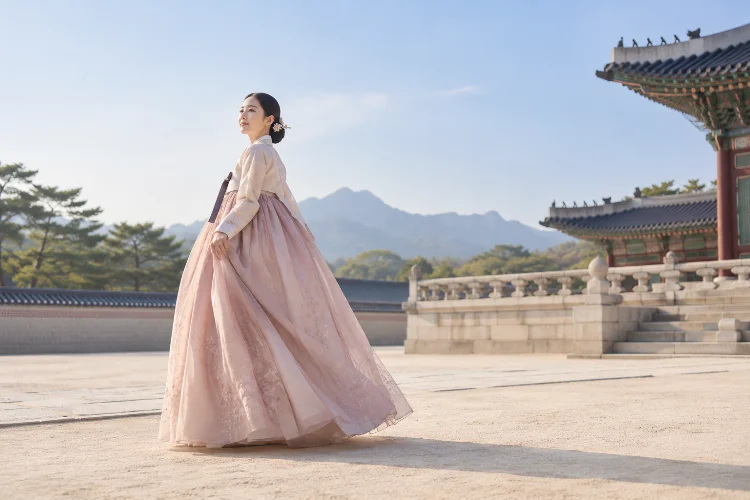
Traditional Korean hanbok is instantly recognizable for its flowing lines, generous volume, and unusual balance between a relatively fitted upper body and a much wider lower silhouette.
Yet the familiar combination of a short jeogori jacket and high-waisted chima skirt did not appear all at once.
The origins of traditional Korean hanbok silhouettes stretch back more than a thousand years, with important foundations visible during Korea’s Three Kingdoms period.
Early clothing already included separate upper and lower garments, but proportions, sleeve shapes, fastening systems, skirt volume, and layering continued to change through Unified Silla, Goryeo, and especially the Joseon Dynasty.
The Victoria and Albert Museum notes that hanbok is not one fixed design but an umbrella term covering centuries of Korean dress, during which sleeve lengths, folds, proportions, and silhouettes repeatedly changed.
Following those changes reveals much more than fashion. Hanbok silhouettes reflect climate, social hierarchy, foreign influence, Confucian values, gender expectations, textile technology, and changing ideas about beauty.
The Three Kingdoms Established the Basic Hanbok Structure
The foundations of hanbok can be clearly seen during the Three Kingdoms period, traditionally dated from 57 BCE to 668 CE.
People in Goguryeo, Baekje, and Silla wore clothing built around separate upper and lower garments. The upper garment was the jeogori, while lower garments included baji trousers and chima skirts.
Murals from Goguryeo tombs provide especially valuable visual evidence.
They show figures wearing long jackets, spacious trousers, skirts, and outer garments suitable for active movement.
The V&A notes that both men and women could wear baji and chima during this early period, while distinctions between male and female silhouettes were less rigid than they later became.
Long outer coats called durumagi also appeared early and remained part of Korean clothing traditions for centuries.
The overall silhouette was comparatively loose.
Rather than sharply emphasizing the waist or upper body, early garments created straight, practical lines. This makes the earliest recognizable hanbok very different from the dramatic upper-versus-lower-body proportions associated with later women’s clothing.
Flat Construction Helped Create Hanbok’s Distinctive Lines
One reason hanbok developed such recognizable shapes lies in its construction.
Traditional garments are largely cut from relatively flat, geometric pieces of cloth rather than being heavily shaped around a three-dimensional body.
The V&A notes that hanbok continues to be constructed mainly through flat cutting and sewing. This approach can reduce fabric waste while creating garments whose shape comes from wrapping, tying, layering, and the movement of cloth rather than complicated fitted seams.
That construction creates the characteristic combination of structure and softness.
A jeogori has clear panels, sleeves, collar components, and front overlap, yet it does not behave like a closely tailored Western jacket.
Similarly, a chima obtains much of its visual drama from gathered fabric rather than complicated shaping.
The Met notes that the chima is wrapped high around the torso and tied toward the front, producing a high waistline and billowing silhoutte.
These structural principles allowed the same basic garment categories to survive while their proportions changed considerably over time.
Unified Silla and Goryeo Introduced New Influences
Korean clothing did not develop in isolation.
After Silla unified much of the Korean peninsula in 668, its close political relationship with Tang China contributed to changes in elite dress. Some garments and court fashions reflected broader East Asian cultural exchange.
During the Goryeo Dynasty, from 918 to 1392, another important influence arrived.
Following decades of Mongol invasions, Goryeo entered a tributary relationship with the Yuan dynasty during the thirteenth and fourteenth centuries. The V&A notes that Mongolian influence became particularly visible in court uniforms and elite clothing.
Yet foreign influence did not simply replace Korean clothing.
Existing garment structures continued to evolve locally.
Jeogori, chima, baji, and outer robes remained central, while imported aesthetic ideas were adapted into Korean dress conventions.
This process is important when discussing traditional clothing.
Cultural heritage rarely develops through complete isolation. Hanbok became distinctive partly because Korean makers repeatedly absorbed outside influences and transformed them into something recognizably local.
Joseon Created the Silhouette Most People Recognize Today
The Joseon Dynasty, lasting from 1392 to 1910, had an enormous influence on the modern image of hanbok.
During this period, women’s and men’s clothing developed increasingly distinctive silhouettes.
Women’s clothing became especially dramatic.
The V&A notes that the length of women’s jeogori gradually decreased from around 60 centimeters to roughly 20 centimeters by the early twentieth century. At the same time, the chima could become increasingly voluminous, particularly among wealthier women.
This created a strong visual contrast.
The short jacket concentrated attention on the upper torso, while the high-waisted skirt expanded outward and downward in soft curves.
Layers of undergarments could enhance the volume further.
The result was a silhouette that almost seemed to float away from the natural contours of the lower body.
That shape became one of hanbok’s most recognizable visual characteristics.
Rather than defining the body through tight tailoring, Joseon women’s dress created beauty through proportion, fabric movement, layering, and space around the body.
Confucian Social Values Influenced Clothing Proportions
Fashion changes are rarely purely aesthetic.
Joseon society was deeply influenced by Neo-Confucian ideas that emphasized hierarchy, social roles, propriety, and modest behavior.
Hanbok participated in this social system.
Clothing could indicate gender, rank, marital status, age, and occupation. The V&A notes that Joseon dress distinctions directly reflected social hierarchy and Neo-Confucian expectations.
Women’s voluminous skirts helped conceal the shape of the lower body, while outer garments provided additional coverage.
Ironically, the shortening of the jeogori also created increasingly striking proportions. The contrast between a tiny upper jacket and expansive lower skirt made late Joseon women’s clothing visually dramatic despite its association with modesty.
Men’s silhouettes remained different.
Men wore jeogori with loose baji trousers, often adding vests, coats, or long outer garments. Spacious trousers supported movement, while long robes could create a vertical, dignified appearance.
So there was never one universal “hanbok silhouette.”
Gender, social position, occasion, and garment layering all affected the final outline.
Chima Volume Became an Important Marker of Status
The chima may appear structurally simple, but its volume could communicate significant social information.
The Met describes the garment as wrapping high around the torso to create a billowing outline.
During Joseon, richer women could use more fabric and more substantial underlayers, producing fuller skirts.
Working women generally needed greater practicality.
Historical images show that their chima could be noticeably less voluminous than those worn by women from wealthy or courtly backgrounds. The V&A highlights this contrast between elite and working-class dress.
This illustrates how silhouette itself could signal class.
Expensive fabric was not the only luxury. Wearing more cloth meant consuming more material, requiring additional textile production, and carrying extra volume that might be impractical during manual work.
Fashion therefore communicated privilege through shape.
A large, carefully supported chima was visually beautiful, but it also quietly showed that the wearer did not need clothing optimized for heavy physical labor.
Jeogori Proportions Changed With Fashion
The jeogori is one of the most interesting garments for tracking hanbok evolution because its basic identity remained stable while its proportions changed repeatedly.
Both men’s and women’s versions share core features such as long sleeves, an overlapping front, and ties used to secure the garment.
The Met notes that jeogori length and sleeve shape changed according to fashion, with women’s versions displaying particularly wide variation between longer and cropped forms.
Climate influenced construction as well.
Summer versions could use lightweight fabric, while padded and quilted nubi jeogori offered insulation during colder weather.
This adaptability explains why silhouette cannot be separated from environment.
Korea experiences distinct seasons, so clothing needed to perform differently in summer and winter.
A padded jeogori creates more physical bulk than a sheer summer version even when the underlying pattern is similar.
Historical fashion therefore depended on more than visual preference – it had to work within Korea’s seasonal enviroment.
Color and Decoration Changed How Silhouettes Were Read
Shape was only part of hanbok’s visual effect.
Color could emphasize different sections of the body and make garment boundaries more noticeable.
Koreans historically worked with silk, hemp, ramie, and cotton, while clothing could be dyed, embroidered, printed, resist-dyed, woven with patterns, or decorated with gold leaf.
White clothing became particularly associated with Korean everyday dress.
At the same time, bright colors played major roles in ceremonial, royal, bridal, and children’s clothing.
Saekdong, the use of repeated multicolored stripes, has roots reaching back to the Goguryeo period and later became strongly associated with festive sleeves and children’s clothing.
The traditional obangsaek color system – commonly associated with red, blue, yellow, white, and black – also shaped Korean visual culture.
These colors could make the division between jacket, skirt, sleeves, collar, and outer layers more visually pronounced.
The silhouette was therefore not simply an outline.
Color directed the viewer’s eye through that outline.
Ceremonial Clothing Expanded the Hanbok Silhouette
Everyday hanbok could be relatively restrained, but ceremonial clothing allowed far more dramatic shapes.
Court women wore garments such as dangui, while bridal clothing could include elaborate outer robes such as hwarot.
These additional layers expanded the body visually.
Wide sleeves, embroidered outer garments, large skirts, headdresses, and decorative accessories transformed the basic jeogori-and-chima structure into a much more imposing ceremonial form.
The Daegu National Museum highlights hwarot among Korea’s important traditional ceremonial garments, while research from the National Palace Museum of Korea documents its importance in royal Joseon weddings.
Ceremonial dress also relaxed some of the visual restraint associated with ordinary clothing.
Commoners could wear unusually elaborate clothing during important life events such as weddings.
That temporary transformation mattered socially.
Hanbok could visually mark the transition from everyday life into ritual time.
The garment did not merely cover the body—it helped create the occasion.
Modern Hanbok Simplifies Historic Proportions
By the twentieth century, Western-style clothing gradually replaced hanbok for much everyday wear.
This changed the garment’s role.
Instead of being an ordinary daily clothing system, hanbok became increasingly associated with holidays, weddings, first-birthday celebrations, ancestral rituals, and formal cultural occasions.
South Korea designated hanbok saenghwal—the wider lifestyle and customs surrounding making, wearing, and enjoying hanbok—as National Intangible Cultural Heritage in 2022.
Modern designers have also adjusted the silhouette.
Daily or contemporary hanbok may shorten skirts, simplify layering, reduce sleeve volume, modify ties, or use modern fabrics to make movement easier.
Korea.net notes that saenghwal hanbok, which developed strongly from the 1990s, sought to preserve the visual language of traditional dress while making it more practical for contemporary life.
This is not the first time hanbok has changed.
Its entire history is one of continous adaptation.
Modern interpretations simply represent the newest stage of that process.
Exploring the origins of traditional Korean hanbok silhouettes reveals that the garment we recognize today is the result of centuries of change.
The Three Kingdoms established the basic relationship between jeogori, chima, baji, and outer garments. Unified Silla and Goryeo introduced new cultural influences, while Joseon dramatically reshaped gendered proportions.
Women’s jeogori became shorter, chima grew more voluminous, and layered clothing turned social ideas about modesty and status into visible fashion.
Modern hanbok continues adapting those historic shapes for contemporary life.
If you want to understand hanbok beyond its beautiful colors, study its silhouette carefully. Look at where the waist appears, how the skirt expands, how sleeves curve, and how garments overlap.
Those proportions contain a visual record of Korean history, social change, and changing ideas of elegance.