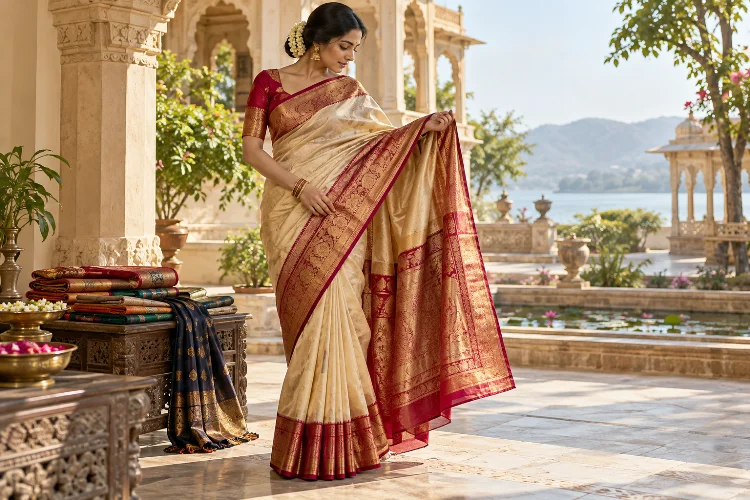
A saree may look simple: one long piece of cloth wrapped around the body. Yet across India, that same basic garment can create dramatically different silhouettes depending on where, why, and by whom it is worn.
Some styles form neat pleats at the front. Others send fabric between the legs like a dhoti, place pleats at the back, display the pallu across the chest, or wrap it around the body several times. These differences are not just fashion choices.
Indian saree draping traditions reflect regional identities shaped by climate, occupation, ceremony, community customs, and local textile production.
The Chhatrapati Shivaji Maharaj Vastu Sangrahalaya notes that regional saree variations have long responded to both cultural traditions and practical occupational requirements.
That flexibility is what makes the saree so fascinating.
Rather than being a single standardized outfit, it functions almost like a clothing system. The fabric stays relatively simple, while communities transform it through folding, pleating, tucking, and wrapping into garments suited to their own way of life.
The Saree Is a Garment Without One Fixed Shape
Unlike tailored clothing, a traditional saree depends more on draping than cutting.
The cloth is usually several meters long, and its final shape is created directly on the body. This gives the wearer enormous control over how tightly, loosely, formally, or practically it is arranged.
Google Arts & Culture notes that sarees can be draped in a large number of ways and that regional styles often emerge from geography and function rather than purely aesthetic preference.
This is important because it means the garment can respond to local life.
A woman working in agriculture may need a drape that allows easy movement. Someone attending a wedding may prefer a style that displays a heavily decorated pallu. Religious ceremonies may require another arrangement entirely.
In South India, an Indian Ministry of Culture publication similarly notes that draping traditions developed in response to climate, customs, occupation, and social position.
The saree therefore acts almost like a flexible design platform.
Its identitiy does not come from the cloth alone, but from what the wearer does with it.
Nivi Became the Most Recognizable Modern Drape
For many people today, the standard image of a saree is the Nivi-style drape.
The fabric wraps around the waist, a series of pleats is tucked at the front, and the pallu falls over the left shoulder. This arrangement is now widely worn across India, even though regional traditions historically offered many alternatives.
Its popularity partly comes from versatility.
The style works with cotton, silk, synthetic fabric, lightweight everyday sarees, or heavy ceremonial textiles. It also pairs easily with a blouse and petticoat, making it convenient for modern urban life.
The widespread adoption of one style shows how clothing traditions can become standardized through travel, photography, cinema, education, and changing social expectations.
Yet regional drapes never completely disappeared.
Instead, Nivi now exists alongside styles used for weddings, festivals, performances, community gatherings, and heritage events.
That coexistence is important.
It shows that Indian dress can become nationally recognizable while still preserving highly local ways of wearing the same garment.
Maharashtrian Drapes Reflect Mobility and Practicality
Maharashtra is especially associated with longer sarees and between-the-legs drapes that create a lower silhouette somewhat similar to a dhoti.
These arrangements can make walking, agricultural work, and other physical movement easier because the fabric separates around the legs rather than hanging as one continuous skirt.
Historical visual evidence also connects this type of dress with Maharashtra. A museum interpretation of Ajanta imagery notes early forms resembling the later Maharashtrian nine-yard saree or dhoti-style arrangement.
Regional variations remain diverse.
The Thakkar drape documented by the Sari Series uses an eight-meter cloth and brings portions between the legs before securing them at the back. The style can also be shortened or lengthened according to working needs.
This relationship between dress and movement matters.
A saree is sometimes imagined as delicate formal clothing, but traditional drapes could be highly functional.
Women working in fields or moving through active daily routines needed clothing that stayed secure.
The resulting silhouette became visually linked with Maharashtrian cultural heritage, showing how practicality can eventually become a powerful regional symbol.
Gujarat Uses the Pallu as a Major Visual Feature
In Gujarat, several draping traditions place particular emphasis on how the pallu appears at the front of the body.
The Seedha Palla style, for example, brings the pallu from the back over the right shoulder so its decorative section becomes clearly visible across the front.
Border&Fall documents this arrangement as a modern urban form that developed by the late nineteenth century.
This makes sense when considering textile design.
Many sarees include especially elaborate decoration on the pallu. Bringing it forward turns that woven or embroidered area into a major part of the wearer’s visible appearance.
Other Gujarati traditions are far more functional.
The Chodhri and Gamthi drapes documented through the Sari Series send fabric between the legs and are designed for rural work, including agricultural activity.
That contrast is revealing.
Even within one state, draping does not express one universal identity.
Urban, rural, occupational, ceremonial, and community traditions can all create different approaches to the same garment.
Regional identity is therefore layered rather than fixed.
Tamil Nadu Shows How Draping Can Carry Ritual Meaning
In Tamil Nadu, saree draping can be closely connected with religious and community traditions.
One of the best-known examples is the Madisar.
This long drape is traditionally associated with Tamil Brahmin communities and uses a complex sequence of folds and tucks. The cloth passes between the legs and wraps around the body in a structure quite different from the common six-yard style.
The Sari Series documents a Madisaru form worn by Iyengar Brahmin women in central Tamil Nadu using roughly nine yards of fabric.
The complexity of the drape gives it ceremonial significance.
It may be worn during weddings, religious rituals, or important family occasions rather than as everyday clothing.
Tamil Nadu also contains other regional systems.
The Saurashtra Katt drape, for example, is linked with Saurashtra communities whose ancestors migrated from Gujarat and settled in Tamil Nadu over many generations.
That makes saree draping a record of migration as well as regional culture.
A wrapping method can preserve memories of where a community came from even after its members establish a new home elsewhere.
Karnataka Drapes Reveal Strong Community Differences
Karnataka offers another clear example of how saree styles can identify particular communities.
The Coorg drape from Kodagu places pleats at the back rather than the front. Its pallu crosses the chest and is brought forward over the right shoulder, creating an instantly distinctive silhouette.
Other Karnataka drapes differ considerably.
The Mysore Shaili uses front pleats gathered into a pouch-like arrangement, while the Karnataka Kachhe sends part of the cloth between the legs and tucks it at the back.
Agricultural and ceremonial communities developed still more variations.
The Halaki Vokkaliga drape uses numerous pleats while maintaining a smooth outer appearance. Other documented Kannada traditions were designed for performers, rural workers, or particular social groups.
These differences show why speaking about “the Indian saree” can sometimes oversimplify the subject.
A single state may contain many distinct methods connected with language, occupation, social group, ritual, and geography.
The same length of cloth can therefore communicate very different cultural information depending on how it is wrapped.
Bengali Draping Creates a Different Silhouette
Traditional Bengali saree drapes also demonstrate how regional identity can be created through fabric arrangement.
Instead of relying primarily on tightly organized front pleats, some historic Bengali styles wrap the cloth more broadly around the body and use the pallu in a more dramatic way.
The Nadia drape documented by Border&Fall was commonly worn by middle- to upper-class Bengali women. The cloth wraps around the waist before the pallu travels over the left shoulder and then returns toward the right side.
The result creates a silhouette different from the now-standard Nivi style.
West Bengal also includes draping traditions connected with Indigenous communities.
The Santhal example documented through the same project uses a two-piece system arranged for practical functionality, showing again that Bengal does not have only one saree identity.
Different drapes can therefore reflect class, locality, ethnicity, and everyday activity.
The saree becomes almost like an accent in spoken language: familiar at a national level, but immediately local when you know what details to notice.
Fabric and Drape Work Together
Regional identity comes not only from wrapping technique but from the textile itself.
A Maharashtrian Paithani, Gujarati Patola, Tamil Kanjeevaram, Bengali Jamdani, or Banarasi silk carries regional information before it is even draped.
India’s textile traditions are extraordinarily varied. The Indian Museum in Kolkata emphasizes that cotton and other fabrics developed distinct regional qualities in material, pattern, color, and production technique.
A Paithani saree, for example, is associated with Maharashtra and is known for richly woven decorative pallus, historically including gold-thread brocade.
How the cloth is draped can either reveal or partially conceal those features.
A front-facing pallu may emphasize complex weaving. A practical working drape may prioritize movement instead. A ceremonial arrangement can display borders and motifs at their most impressive angles.
The wearer is effectively completing the textile design.
Weaver and wearer both contribute to the final appearance.
Regional Drapes Continue to Change
Traditional saree draping is not frozen in history.
Urbanization, mass media, migration, changing work environments, and modern fashion have all influenced how women wear sarees.
The Nivi style has become dominant in many contexts because it is widely understood and relatively easy to reproduce. Pre-stitched sarees and contemporary draping experiments have simplified the process even further.
At the same time, interest in regional traditions has increased through museums, cultural documentation, designers, and digital projects.
The Sari Series, for example, documented numerous drapes from fifteen Indian states to highlight how varied the garment remains. Google Arts & Culture similarly emphasizes that sarees can function as heirlooms, everyday workwear, ceremonial clothing, and expressions of personal memory.
Preservation does not necessarily mean everyone must wear older drapes every day.
It means keeping the knowledge available.
When younger generations learn why certain pleats face backward, why cloth passes between the legs, or why the pallu is worn in front, the garment retains its cultural context instead of becoming only a visual style.
Indian saree draping traditions reflect regional identities because the garment adapts to the people who wear it.
Maharashtra developed practical between-the-legs arrangements, Gujarat uses both work-oriented drapes and styles that prominently display the pallu, Tamil Nadu preserves complex ceremonial wrapping traditions, while Karnataka and Bengal contain numerous community-specific variations.
These differences grew from climate, occupation, social customs, migration, ritual, and local textile production.
That is what makes the saree so remarkable. One largely unstitched piece of fabric can become dozens of culturally distinct garments without changing its basic form.
If you want to understand Indian textile heritage more deeply, look beyond the weave and color. Study how the cloth sits on the body. The pleats, tucks, and pallu placement often tell just as much about regional culture as the fabric itself.